Posted in Business Practice

No More Gates!!! (Updated 12/4/24)

Importance update from the Office of State Fire Marshal:
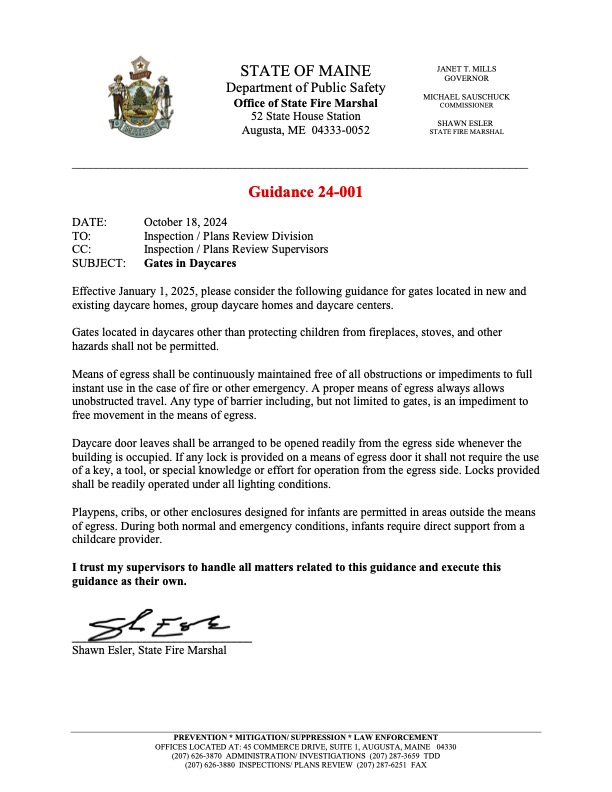

If you have any questions or concerns, or need any clarification or help understanding these requirements, please do not hesitate to contact the State Fire Marshal’s office where you can be connected with one of our inspectors who can provide you with assistance.

Here’s more information from Office of State Fire Marshal ~ from a November 25, 2024 memo:
The Office of the State Fire Marshal recently released internal guidance to its inspectors pertaining to gates and egress in daycares. This guidance was followed up with training and discussions related to this code interpretation. We were made aware this guidance was distributed by DHHS and prompted valid questions from daycare operators which led to this informational packet.
We have the utmost respect for our daycare operators and the challenges they face on a regular basis. We are committed to public education, sharing our experience with fire safety, and preventing death and injury from fire or other emergencies. Our daycare providers are stewards of safety, and we look forward to building strong working relationships with one another.

Why was this guidance issued? The Office of the State Fire Marshal is required to follow existing laws and regulations adopted through legislative action. During some routine daycare inspections gates, playpens, and other devices were observed preventing both adults and children from travelling to exit doors in an emergency.
We have further observed special locking arrangements on doors intending to provide safe exits. Since egress obstruction has been observed across the State in daycare and educational facilities, our office felt compelled to begin informing daycare providers of potential egress concerns.

Why January 1st, 2025? Due to the fact we cover the entire State of Maine, we issued guidance to address consistency across the State. Fair and consistent application of code is important to us. We chose this date as a goal to begin our educational campaign.

What specific laws/code prompted this guidance? Every component in the means of egress (an unobstructed route from any point in a building to a public way) must be operable by, and under the control of, the occupants attempting egress. One of the biggest obstacles a person can encounter, preventing them from free egress, is a locked door. Approaching a noncompliant locked door
unexpectedly and without the means necessary to operate it is an example of when egress becomes outside of an occupant’s control. This can hinder evacuation time and prevent occupants from getting to their point of safety. An unfortunate increase in hostile events, and similar threats has also increased the presence of security features on door assemblies within the means of egress to prevent unwanted entry. This added security, particularly where door assemblies to exit stairs and main egress routes are involved, could be disastrous in the event of a fire or other emergency. The provisions of NFPA 101, Life Safety Code, are aimed at preventing locked door assemblies in means of egress in the event of fire. The Code has attempted to balance this objective of free and unobstructed egress while also maintaining features that are essential to security within the building.

Are all gates not allowed? Our office recognizes the need for gates to protect children from hazard areas. Off limit areas of a home, separation of pets from children, guarding a stairway from access, keeping children away from appliances, stoves, or heating devices, etc. are all examples where gates may be utilized (when approved by inspector/AHJ). We trust that daycare providers can effectively identify and mitigate hazard areas.
What happens if an inspector finds a gate in the means of egress? In almost every situation or finding, our office works with our constituents to find a resolution to potential code concerns. We strive for voluntary compliance and our inspectors exercise discretion. Ninety nine percent of the time enforcement action is not required, and we consider that a last resort to address gross negligence.
Can I have a door with a lock to prevent children from going outside? You can always lock your doors from someone entering your facility. Locks can be installed to prevent unwanted entry from outside, but not on the egress side of the exit doors. Single Action Locks are ideal for daycares. There are a wide variety of locksets to choose from, so what makes these locks so great for daycare facilities? In short, it’s because these locks offer numerous safety benefits that allow for additional security while still being easy to operate. For one, there is no key or special knowledge/effort required to operate these locks when exiting a building. Even when the door is locked from the outside with a key, all you need to do is push the lever down or turn the knob to exit the building. The convenience of this feature is perfect for daycare doors that are frequently used. These
locksets are also equipped with an interconnect device between the knob/lever and the deadbolt, requiring a single action to unlock both simultaneously. It does not lock behind you, making it a quick, easy exit without locking anyone out.

Are there options other than gates to prevent children from accidentally exiting? There are many options including delayed egress locking arrangements, sensor releasing electronic locks, alarms,
and other devices recognized by fire code to assist. Depending on your situation, our inspectors can provide onsite recommendations. For example, if you have a fire alarm and sprinkler system, you can use delayed egress that sounds an alarm for 30 seconds before the door releases. We cannot, however, recommend brands or specific companies. Any installation of the delayed, sensor releasing locks or other devices will need to obtain approval or possibly permitting prior to installation. Half doors are an acceptable replacement for a gate used in an egress path. They are on hinges, swing, and have a door handle.
Can I have a playpen, crib and other items designed to contain children? Of course, play pens, cribs and other items made for children’s use, are to be used for their design and age group. In most cases this would apply to infants. In emergencies, the children would require rescue from staff. We ask that they are not placed in front of a doorway, corridor, hallway, escape window, or exit path-and should be approved by inspector or supervisor. If you are putting up permanent structures and walls, please contact our office to see if you need a construction permit for daycare centers (more than 12 children).
Can I have a gate or fenced outside area? Of course, the intent of our guidance was to primarily address obstructions inside a daycare home or center. The outside exit path outside should be clear of obstructions, including snow, so in the event of a fire or major emergency everyone can keep a safe distance for the arrival of emergency services. The exterior gates would also need to comply with egress requirements.


Here’s some additional info about egress points. Here’s the full page: https://www.maine.gov/dps/fmo/sites/maine.gov.dps.fmo/files/inline-files/childcarefacility_fixed.pdf?.

Day care facilities are divided into three general groups according to the number of children or adults which are cared for at one given time.

  1. Day care centers- offering care to more than 12 children or adults

The Department of Public Safety does not recognize the act of removing the sashes of a double hung window to achieve the minimum of 5.7 square feet of clear opening. The method used by this
department in measuring the clear opening of a window is illustrated below. This method uses the
opening when the widow is in its normal open position.

The requirements for a secondary means of escape from all rooms used for day-care purposes still
remains.

Smoke detectors must be installed in all areas used for day-care and in all napping rooms used by the day-care clients. In new group day care homes smoke detectors must be installed on all floor levels of the building. All smoke detectors must be supplied power by the building electrical system. In existing day care facilities one required smoke detector must be supplied by the building electrical system. Again in all existing day care facilities, all floor levels must have a smoke detector. All single station smoke detectors, (detectors not interconnected with other detectors or connected to a fire alarm panel) must be tested on a monthly basis and a record kept at the facility. New smoke detectors are available which are generally powered by the building electrical service and also have a battery contained within which will keep them effective even during a power outage. All new installation of smoke detectors requires that they are powered by the building electrical supply and must have a battery backup.

If basements are used for day care purposes an exit with a normal side hinged door (not a bulkhead) must be provided to allow exiting directly to the outside. Remember, all rooms used for day care purposes must have a same egress window or door as required for all other floor levels. Normal basement windows installed during construction are most often too small to meet these requirements.

Exceptions to fire codes exist when fully sprinkler protected. Many new homes in the State of Maine are being constructed with a residential sprinkler system installed at the time of construction. These residential sprinklers systems have been proven in many other states to be life safety systems.


Posted in Business Practice, ECE Information

Releasing of Child Records (question)

FCCAM PLC has a new section in the sidebar of the website that allows for providers to ask questions and the PLC will reach out to find the answers. When appropriate we will share the answer to the wider community and pass the question along to partner organizations to inform them of an issue.


We recently had a provider reach out about their responsibility to release information they recorded around a question of possible child abuse and neglect.

Here’s the general situation information we received:

A question of possible child abuse and neglect at home occured. Provider followed their policy and wrote an incident report and reported it to the hotline number. Child is no longer in the program. Parent sent an email requesting all of the information from the child’s records.

Question: Does the incident report need to be included with the other material in the child’s record?

The PLC reached out to Licensing Supervisors. Following are the keys points from our conversations with them.

  • FCC and Facility Licensing Rules require Child Abuse and Neglect reports to be kept separate from Children’s Records.
  • Being maintained separately means they do not need to be released as part of a Parent’s request for their Child’s record.
  • If for some reason a program isn’t keeping CPS reports in a separate file they should going forward.

Here’s the Licensing Rule language:

A-C. Record Management/ Section 5. Record Management and Retention

A. Record management. Providers must comply with the following:

4. Maintain a separate record of all reports of alleged Child Abuse or Neglect made in accordance with 22 MRS §4011-A.

A-D. Section 6 / Reporting Requirements

B. Mandatory report of suspected Abuse or Neglect. Any provider suspecting Abuse or Neglect must immediately report this information to Child Protective Intake Services, 1-800-452-1999, TTY 1-800- 963-9490 which is staffed 24 hours a day, 7 days a week.
1. The provider must maintain documentation, not maintained in the Child’s record, that a report has been made.

2. All reporting of suspected Child Abuse or Neglect, and serious injuries of a Child who is under six months of age or otherwise non-ambulatory, must comply with 22 MRS §4011-A.


Here’s a link to Maine’s Mandated Reporter Worksheet that can be used to document reports made to CPS intake.


FCCAM encourages providers to review their Mandated Reporter policy and check when they completed their last Mandated Reporter training. Renewal is required every 4 years.

Posted in Business Practice

Wading Pools?

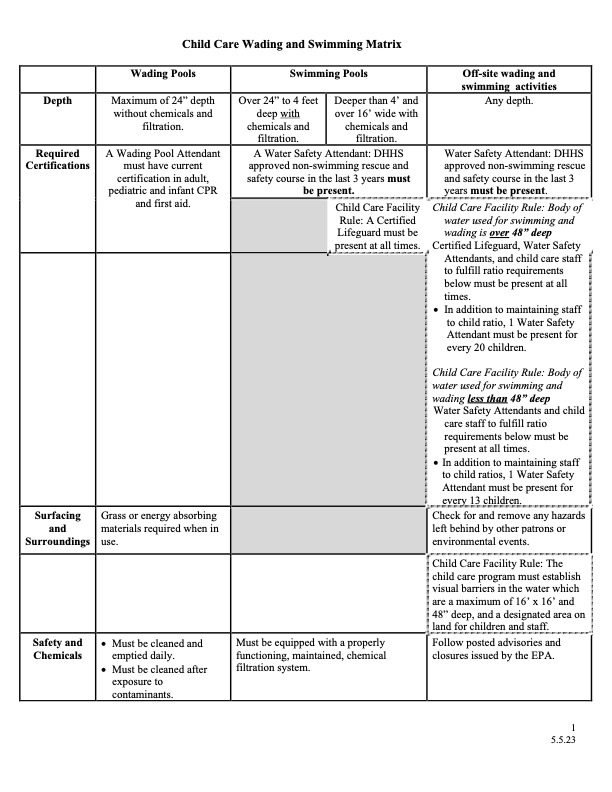
Always lots of questions as the weather warms up around “wading pools“. Whether inflatable or hard plastic here’s what we know:

Definition:

Wading Pool: Ch.32 1(B)(67) and Ch. 33 1(B)(57) – Wading Pool means:

  • a pool with a water level maintained at 24 inches or less,
  • is no more than 4 feet in diameter.
  • does not require a filter
  • may not contain chemically treated water.

Key Notes:

  • Wading pool needs to be empty of water when not in use and clean after exposure to contaminants.
  • Adult supervision (Safety Attendant) must be direct at all times wading pool is in use.
  • Safety Attendant for wading pool needs to be currently certified in adult, pediatric and infant CPR and first aid.
  • Placed for usage on grass/energy absorbing materials. Hardtop/Pavers are not safe surfaces for using on.

Information covering all swimming/wading activities – sheets provided from Licensing:

Posted in Business Practice, DHHS / OCFS

2024 Maine Child Care Market Rate Survey

Child Care Affordability Program (CCAP) reimbursements will see the 2024 Maine Child Care Market Rate increase go into effect on July 6, 2024.

Here’s a detailed pdf showing county, full-time, part-time and half  and quarter breakdowns: 2024 Market Rate effective July 6, 2024. 

Reminder: Maine reimburses up to the market rate, so if your posted rates are below the market rate FCCAM encourages you to raise your posted rates accordingly.

Participation in subsidy programs is voluntary.

The release of the 2024 Maine Child Care Market Rate Survey has raised some questions from providers. FCCAM PLC has pull out information from the 142 page survey report that we felt would answer some of the questions/comments we are hearing.


FCCAM encouraged providers to complete the market rate survey to the best of their ability as any information above just what you charge would be helpful. A higher participation provides better data to OCFS . ~ The Federal government encourages states to include a cost of care analysis in the rate setting process. ~ Cost of care provides a better picture of cost and should increases the market rates.

All licensed child care facilities (834) and family child care providers (710) were invited to participate in the most recent survey. In total, 64.4 percent of providers participated in the survey, including 62.5 percent of child care facilities and 66.8 percent of family child care providers. Figure 1 illustrates participation rates by provider type and county. 

Federal regulations do not dictate the specific rates paid by state child care subsidy programs. The Child Care Defense Fund (CCDF) does note the importance of state child care subsidy programs affording recipients access to a wide array of child care options.

Federal guidelines recommend, but do not require, that states establish subsidy payment rates at the 75th percentile of current market rates. Maine began setting its subsidy payment rates at the 75th percentile in 2017.

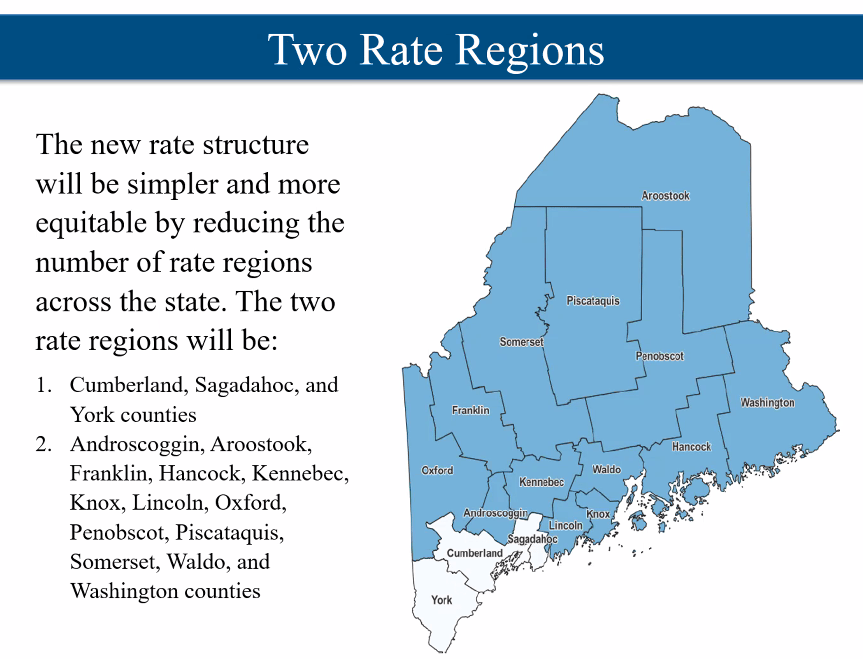
OCFS’s cost analysis showed little difference across Maine counties in the cost of providing care – 10% for family child care and 5% for child care centers. However, reimbursement rates in some parts of the state have been 45% lower than in others. OCFS could have moved to a flat state rate, but decided a shift to two regions would help to reduce geographic rate disparities without be to significant a change at this time.

For 2024, OCFS has adopted rate percentiles less than the 75th percentile for some payment rates. All rates reflect at least the 50th percentile, meaning that every payment rate covers the rate charged by at least half of the state’s providers for a given age group within a given region. If the selected rate benchmark would have resulted in a rate reduction, OCFS made a policy decision to maintain the existing rate in these instances.

This change from a flat 75% has led to some of the confusion for providers. Looking at the following chart found in the full report, the BOLD* is what the 2024 full-time rate will be for the listed region. The other percentiles shown are just for comparison.

The Child Care Defense Fund (CCDF) has a key goal to increase the number and percentage of low-income children in high-quality child care settings. Broad provider participation in Maine’s two child care subsidy programs – the CCAP and the TANF/ ASPIRE child care subsidy – is important to ensure enrolled families have access to a variety of child care options within their local area.

OCFS data indicates that 523 of the 834 child care facilities (63 percent) and 401 of the 710 family child care providers (56 percent) participate in the CCAP. This is a notable increase in the rate of participation since 2021. More than 90 percent of participating programs place strict enrollment caps of no more than 30 percent of total enrollment.

The survey asked providers that do not participate in the CCAP for their reasons. The primary reported barriers related to available capacity, low CCAP payment rates, and administrative rules and processes related to billing and reimbursement. OCFS has reported that they are working on new programs to facilitate billing, reimbursement, and support. Federal regulations on CCDF continue to change and OCFS is working to make changes to online management systems, reimbursement by enrollment vs attendance, and reimbursement at market rate. As these changes happen over the next year OCFS will keep providers informed.

Another change is child care staff can now participate in the subsidy program if they meet eligibility. Forms are now available for any qualifying staff.

Also beginning July 1, 2024, the income limit for CCAP will increase from 85 percent of the state’s median income (when adjusted for family size) to 125 percent of the state’s median income.

Additionally, recent legislation phases in a number of changes to the program by 2030, including further expanding eligibility to families earning up to 250 percent of the state’s median income, and limiting child care costs to no more than seven percent of a family’s income.


Hopefully this information will help you as you work your business budget, consider changes to your program, etc.

Please reach out if you have questions and we’ll see what we can find out.


New Child Care Market Rates Meeting Recording

2024 Market Rate Survey Final Report

Posted in Business Practice

CDC updates and simplifies respiratory virus recommendations

From CDC Press Release on Friday, March 1, 2024 ~

CDC released today updated recommendations for how people can protect themselves and their communities from respiratory viruses, including COVID-19. The new guidance brings a unified approach to addressing risks from a range of common respiratory viral illnesses, such as COVID-19, flu, and RSV, which can cause significant health impacts and strain on hospitals and health care workers. CDC is making updates to the recommendations now because the U.S. is seeing far fewer hospitalizations and deaths associated with COVID-19 and because we have more tools than ever to combat flu, COVID, and RSV.

“Today’s announcement reflects the progress we have made in protecting against severe illness from COVID-19,” said CDC Director Dr. Mandy Cohen. “However, we still must use the commonsense solutions we know work to protect ourselves and others from serious illness from respiratory viruses—this includes vaccination, treatment, and staying home when we get sick.”

As part of the guidance, CDC provides active recommendations on core prevention steps and strategies:

  • Staying up to date with vaccination to protect people against serious illness, hospitalization, and death. This includes flu, COVID-19, and RSV if eligible.
  • Practicing good hygiene by covering coughs and sneezes, washing or sanitizing hands often, and cleaning frequently touched surfaces.
  • Taking steps for cleaner air, such as bringing in more fresh outside air, purifying indoor air, or gathering outdoors.

When people get sick with a respiratory virus, the updated guidance recommends that they stay home and away from others. For people with COVID-19 and influenza, treatment is available and can lessen symptoms and lower the risk of severe illness. The recommendations suggest returning to normal activities when, for at least 24 hours, symptoms are improving overall, and if a fever was present, it has been gone without use of a fever-reducing medication.

Once people resume normal activities, they are encouraged to take additional prevention strategies for the next 5 days to curb disease spread, such as taking more steps for cleaner air, enhancing hygiene practices, wearing a well-fitting mask, keeping a distance from others, and/or getting tested for respiratory viruses. Enhanced precautions are especially important to protect those most at risk for severe illness, including those over 65 and people with weakened immune systems. CDC’s updated guidance reflects how the circumstances around COVID-19 in particular have changed. While it remains a threat, today it is far less likely to cause severe illness because of widespread immunity and improved tools to prevent and treat the disease.  Importantly, states and countries that have already adjusted recommended isolation times have not seen increased hospitalizations or deaths related to COVID-19.

While every respiratory virus does not act the same, adopting a unified approach to limiting disease spread makes recommendations easier to follow and thus more likely to be adopted and does not rely on individuals to test for illness, a practice that data indicates is uneven.

“The bottom line is that when people follow these actionable recommendations to avoid getting sick, and to protect themselves and others if they do get sick, it will help limit the spread of respiratory viruses, and that will mean fewer people who experience severe illness,” National Center for Immunization and Respiratory Diseases Director Dr. Demetre Daskalakis said. “That includes taking enhanced precautions that can help protect people who are at higher risk for getting seriously ill.”

The updated guidance also includes specific sections with additional considerations for people who are at higher risk of severe illness from respiratory viruses, including people who are immunocompromised, people with disabilities, people who are or were recently pregnant, young children, and older adults. Respiratory viruses remain a public health threat. CDC will continue to focus efforts on ensuring the public has the information and tools to lower their risk or respiratory illness by protecting themselves, families, and communities.

This updated guidance is intended for community settings. There are no changes to respiratory virus guidance for healthcare settings.

Posted in Business Practice

Your Social Security Benefit: How It’s Figured

Why is FCCAM posting on this topic? Many providers take the maximum amount of deductions they can each year. That means your net income is significantly less than gross, so ultimately your Social Security benefits will also probably be less than you were expecting.

It’s important to understand how social security benefits are figured.

  • Benefits are figured off your lifetime earning – the net income you pay yearly taxes on, NOT your gross income.
  • Adjust or “index” your actual earnings to account for changes in average wages since the year the earnings were received.
  • Calculate your average indexed monthly earnings during the 35 years in which you earned the most.
  • Apply a formula to these earnings and arrive at your basic benefit, or “primary insurance amount.”

How do you find out about your status for Social Security benefits?

Set up a personal “my Social Security” account. This site gives you access to: an estimate of your personal retirement benefits; see the effects of different retirement age scenarios; an online Social Security Statement (Statement).

Review your earnings history to make sure everything is accurate. This is important, because your benefit amount is based on how much you’ve earned over your lifetime. If that information is wrong, you may not get the full amount you’re entitled to.

Important Things to Know about Your Social Security Benefits

  • Social Security benefits are not intended to be your only source of retirement income. You may need other savings, investments, pensions, or retirement accounts to make sure you have enough money when you retire.
  • You need 40 credits of work (at least 10 years) to qualify for retirement benefits. The amount of your benefit is based on your highest 35 years of earnings. If you have fewer than 35 years of earnings, years without work count as 0 and may reduce your benefit amount.
  • To keep up with inflation, benefits are adjusted through “cost of living adjustments.”
  • If you get retirement or disability benefits, your spouse and children also may qualify for benefits.
  • If you and your spouse both work, use the my Social Security Retirement Calculator to estimate spousal benefits.
  • If you are divorced and were married for 10 years, you may be able to claim benefits on your ex-spouse’s record. If your ex-spouse receives benefits on your record, that does not affect your or your current spouse’s benefit amounts.
  • Learn more about benefits for you and your family
Posted in Business Practice, DHHS / OCFS

Required Evacuation Drills Clarification

Here’s the initial response: ANY type of emergency disaster drill counts…some options that could be practiced: shelter in place, lost child, simulated relocation (staff, NOT KIDS TRANSPORTED unsafely in cars), severe weather, unknown person/suspicious situation, coming inside due to an emergency, etc.

Here’s the clarification: The language of the Licensing Rule specifies a requirement for 2 evacuation drills in rule SECTION 14. ENVIRONMENT AND SAFETY /Q. Emergency preparedness plan / 2. The Provider must conduct an evacuation drill at least twice a year and the dates must be recorded and be available for review. (Same section for Facility Rule. Q/2 language: The Child Care Facility must conduct an evacuation drill at least twice a year and the dates must be recorded and be available for review. A simulated drill is acceptable.)

The key word is “evacuation“.

Shelter-in-place drills of any kind that do not include evacuation, do not meet the emergency drill needed for rule compliance.


Let’s look at this more:

  • You already do monthly fire drills with the smoke alarm.
  • You already have a running log for fire drills.
  • You need to add 2 noted Evacuation drills to that log.
  • Reminder: FCC Rule Section 5/A-5: A record of fire drills for the preceding three years must be available for inspection by the Department of Health and Human Services, the Department of Public Safety, State Fire Marshal’s Office, and local fire inspectors.
  • For fire drills, you use different exits.

Practice any of the other types of safety drills you think would support the children, such as shelter-in-place, reverse evacuation, medical emergency and lost child. Log any Safety Drill you practice.

For evacuation drill:

  • Simulate it: practice the steps to gather and leave. Use the language specific to evacuation vs fire.
  • As part of your Emergency Preparedness Plan you should have multiple alternate sites you could evacuate to. It is recommended to have one you can walk to. For a walking site you could actually gather and leave your premises.
  • You are not required to transport children off the premises. If you do transport children as part of your program, you can practice transporting as part of your drill. If you do not transport, you can practice what loading everyone into a vehicle would be like in an emergency. Simulating this does not put any child in harms way as your vehicle is not running at any point. You just practice loading in, sitting still, and unloading. You could then pretend you are at the safe site and what would you do there?
Posted in Business Practice, Opening a FCC

What’s It Mean to be a Family Child Care Provider?

The answer to that question is as varied as family child care providers are, but we do have a common foundation.

We know that family child care providers are in this business because of the children, but it’s more than just taking children into our homes. Family child care providers are first and foremost small business owners. We have chosen this career path to financially provide for ourselves and our families. If you question if we qualify as a small business, look at the process we all go through to open and to remain open. The regulations are covered in our 62 page FCC Licensing Rule that we must meet. These minimum health and safety regulations cover everything from how to store breast milk, to the annual professional development we need, to the temperature we need to maintain within our program.

As successful small business owners it is essential to build a business plan, look at branding and marketing, and cover benefits like health insurance and retirement. Without considering how we will run our small business we cannot do what we opened our doors to: support children and their development.

The purpose of our small business qualifies us as early childhood education and care professionals. When most hear “educator” they immediately think of public school teachers, but educator has a broader meaning: a person who helps students to acquire knowledge, competence or virtue. Family child care providers, in fact all in the child care workforce, are educators.

Family child care providers are more than just educators.

We are…..

Food service managers:

  • Order food and beverages, equipment, and supplies
  • Oversee food preparation, portion sizes, and the overall presentation of food
  • Inspect supplies, equipment, and work areas
  • Ensure that employees comply with health and food safety standards

Property managers:

  • Keep the property in safe and habitable condition.
  • Responsible for the physical management of the property, including regular maintenance and emergency repairs.
  • Quality improvement efforts

First aid responders:

  • Specialized training
  • First to arrive and provide assistance at the scene of an emergency, such as an accident, or natural disaster

Bookkeepers:

  • Perform payroll functions in an accurate and timely manner, and submit payroll taxes
  • Conduct reconciliation of all accounts on an as needed basis
  • Maintain and balance the general ledger in an accurate, complete, and up-to-date manner
  • Perform all activities related to the accounts payable function
  • Perform account receivable functions including invoicing, deposits, collections, and revenue recognition
  • Prepare financial reports through collection, analysis, and summarization of data

Housekeepers and house cleaners:

  • Dusting, vacuuming, sweeping and mopping the floors in all rooms.
  • Cleaning the bathrooms, including mirrors, toilets, showers and baths.
  • Cleaning the kitchen, including wiping down appliances, counters, sinks and cabinet doors.
  • Washing and drying dishes and putting them away.
  • Changing bed linens and making the beds.
  • Washing, folding clothes.
  • Cleaning interior windows.
  • Removing garbage and recycling.
  • Restocking personal items such as toilet paper, tissues, etc.
  • General tidying of the rooms. This includes putting away toys, decluttering and light organizing.
  • Running errands.
  • Caring for pets.

We might also be employers and be responsible for all the tasks involved with hiring, training, evaluating, and firing.

Most importantly we are educators!

We:

  • Maintain a safe and comfortable environment
  • Provide age-appropriate active supervision and behavior guidance
  • Develop schedules and enforce routines
  • Plan and implement lessons
  • Observe, gather and document child’s growth and behavior
  • Gather and communicate observations with child’s parent/legal guardian, providing supporting resources as appropriate
  • Address cultural and/or special needs. This includes emotional, physical or educational. Let’s just look at food for a couple of examples: If a child has a food allergy, the provider must be aware of the content of the food the child is offered or is eating. / If a child’s culture or religion doesn’t allow certain foods we offer acceptable substitutes.

As family child care providers we have chosen an incredible career. It is both challenging and rewarding. When someone asks “What do you do for work?” Proudly answer: “I’m a small business owner. ~ I’m an early childhood educator and care professional. ~ I operate a licensed family child care business.”

Posted in Business Practice

The Value of an Employer Identification Number

Do you have an EIN – an Employer Identification Number (Federal Tax Identification Number)?

If No, you should strongly consider getting one as it replaces the need to share your social security number.

Through the EIN you are registering your business with the federal government, so your EIN works in place of your social security number for business related items (ie. set up a bank account, apply for loans, and paying taxes).

This is a free service offered by the Internal Revenue Service and you can get your EIN immediately. Beware of websites on the Internet that charge for this free service.

You may apply for an EIN in various ways.  You will need Form SS-4 PDF for fax or mail in.

  • You get your EIN immediately by applying online (the preferred method). The information is validated during the online session, and an EIN is issued immediately. The online application process is available for all individuals whose principal business, office or agency, or legal residence, is located in the United States or U.S. Territories.
  • You can fax a completed Form SS-4 to the service center for your state, and they will respond with a return fax in about one week. If you do not include a return fax number, it will take about two weeks.
  • If you apply by mail, send your completed Form SS-4 to the address listed under service center, expect at least four to five weeks to receive your EIN.

Not sure if it’s worth your time, because you ‘ve been sharing your social security number with client families for years and haven’t had any problem. Or maybe you’re thinking “I’m going to be retiring shortly”. Here’s a recent event that has raised the value of having an EIN:

The Office of Child and Family Services recently shared contact information on licensed providers that were level 3 and 4 on Quality for ME with the Department of Education . This was done to support providers possibly working with local school district in offering distant learning within their programs. OCFS was made aware that for providers without an EIN their social security numbers were part of the information shared. The situation was immediate handled between OCFS and DOE, but this is a perfect example of the value of having an EIN.

But, I’m not a Quality for ME level 3 or 4, so the OCFS release didn’t impact me.

Legal guardians need an identification number from their family child care provider so they can claim their child care tax credit. Without an EIN you are providing your social security number. Do you really want families and whomever is doing their taxes to have your social security number?

Simple Fact: Having an EIN helps you avoid identity theft problems.

Once an EIN has been assigned, whether the EIN is ever used to file Federal tax returns, it is never reused or reassigned to another business entity. If you later determine you do not need the number, the IRS can close your business account after submission of the necessary paperwork.


Posted in Business Practice, Opening a FCC

Opening a Family Child Care: Part 3 ~ Equipment

In Part 1, we discussed if fcc was a good fit professionally for you, the need for developing your policies and meeting the requirements of licensing. In Part 2, information was provided on the need for a business plan to get a handle on what a sustainable budget would look like for your small business. 

In Part 3, we are looking to provide some direction around the type of equipment that has continually shown it’s value in meeting the developmental needs of children. Every family child care is unique and thus it’s impossible to say “Here get this….” or even “You need this….”.  Deciding – what equipment works for your program and space / what is really necessary / and what can be put on the future purchase list – is only a decision that you can make. You might be surprised with how easy it is to provide a nurturing, developmentally responsive environment for the children you are looking to provide care for. 


Now it’s time to focus on preparing your space for opening?

This starts with being sure your space is safe. That information is well covered in the current Family Child Care Licensing Rule. You should read the Rule over carefully, noting areas of concern and address those concerns before moving items in.

Following are some questions to consider before you acquire any specific piece of equipment. Reminder: Less is More.

  • Is it sturdy, well-designed and built to last?
  • Is it safe? Does it meet current safety standards?
  • Is it easy to keep clean?
  • Will it retain children’s interest over time?
  • Can it be used in a number of different ways, by different ages?
  • Can it be used by children of all abilities?
  • Does it fit well with what I already have?
  • Storage needs

Starting out you will probably have limited funds, so let’s look at some ideas for acquisition of the equipment you might use in family child care. 

  • Find DIY directions. You’ll just need the skills and materials to complete the DIY project.
  • Is it available through local online yard sale sites?
  • Can you find at local thrift store?
  • Do you need long term or can you borrow?
  • Can you purchase local and transport? Or is it best to purchase with delivery?

Reminder: Not all equipment will be used by all ages, but much of it is adaptable across the ages.

While the aim of a nurturing child care environment is to encourage children to freely explore, choosing independently from a variety of activities, it also needs to be safe. You also have to think about basic furnishings and equipment that will support the daily routine care activities such as food preparation, cleaning, personal hygiene and paperwork, that will be part of your unique program. 

Let’s look at some general equipment recommendations for a mixed ages program that provides care for infant thru school-age derived from provider discussions. There are providers who will specialize in infant/toddler care, preschool programming or after-school care, but a majority of providers service mixed ages. Those that specialize can also get ideas from our equipment listings.

General Program or Routine Equipment:

  • Office: It is important to have a secure place for you to keep information, first aid kit/emergency bag, notice board for parent information…. This can be as simple as a file box, tote bag and a bulletin board.
  • Maintenance: vacuum cleaner, general cleaning supplies. Since you are doing business from your home you should already have the equipment needed for general maintenance/cleaning. 
  • Bathroom Equipment: sink, toilet. Again it’s your home and Licensing requires a working bathroom facility, but let’s look at what else you might need:
    • liquid soap dispenser – Easier for children to handle, cleaner 
    • paper towel dispenser or individual cloth towels for each child – The dispenser does not need to be a commercial dispenser. You can have a simple paper towel hanger or use a basket for bulk folded paper towels. Cloth towels will need to be designated for each child and laundered.
    • potty chairs – Floor setups need to be cleaned between uses. The toilet seat adaption seat will need a stool to access the toilet height.
    • toilet tissue dispenser – You probably also already have one of these as part of your home setup. For young children and to save on toilet tissue you might find a small basket you can place on the back of the toilet that holds tissue length you have pre-pulled works easily and saves on overuse of toilet tissue.
    • changing table or changing mats – This is a provider preference. It is ok to change children on the floor as long as you have a cleanable surface, such as a changing mat, under them. Changing stations require a designated space.
    • container for soiled diapers as needed – Again preference, but needs to be covered and secure from children.
    • sturdy step-stool – 1 stool can be used for both sink and toilet.  If using a changing table you will probably want another step-stool for that.
  • Kitchen: drinking cups – Whether you provide snacks and meals or not, you need to have water available for children at all times. They each need their own cup.
  • If providing food you will need: cutlery, refrigerator, trash receptacle (closable), sink, stove, cooking utensils, pots and pans, baking pans, mixing bowls – All this should already be part of your home environment. 
    • You may want to consider unbreakable plates, bowls, cups that are sized for children.

General Child-sized Furnishings: 

  • a cot or foam mattress with waterproof cover for each napping child (non-infant)
  • a crib for each infant – These need to meet current safety standards. Pack and plays are acceptable.
  • child-size table* – These do not need to be special child tables, or a certain shape. It does not even need to be high enough for child size chairs to fit under. It can be a low table that children sit around on the floor or on pillows. It really the stable flat surface you want.
  • child-size chairs* – One for each child if want them at a table high enough to fit chairs.
  • chair/rocker – You want something an adult can sit in.
  • child-proof gates – following fire safety requirements
  • large wall mount mirror (shatterproof) – All children love having mirrors available, but especially developmentally important for infant/toddlers. 

*child size tables and chairs are ideal if you have the space, but they are not necessary. If you use your regular table and chairs you will need to be sure seating is safe/secure.

Storage: Your storage space will have a large impact on both the amount of and size of the equipment you have within your program.

  • Daily storage: open units to store toys and equipment, and cubby or other private storage area for each child (e.g. individual coat hook with drawstring bag or plastic bin). 
  • For toy storage you can use baskets, purchased storage tubs, recycled cardboard boxes, etc. If your space is shared with family or designated for child care alone might impact how you handle storage. There are many creative ideas for storage options online.
  • Plan on larger storage needs for additional supplies and/or for “Rotating” sets of toys. Rotating toys avoids crowding and overstimulation within your program space. Rotation adds a degree of surprise and enjoyment when unfamiliar equipment replaces the all-too-familiar. 

Soft Spaces/ Private Places: This is not necessarily an area that you would think is a must have for equipment, but children frequently need the assurance of a soft, comfortable, safe place. Small, quiet retreats allow for times when children want to be alone, or one-on-one with a caregiver.  

  • Bean bag chair, oversized pillows, or multiple older pillow recycled into one large pillow case. Be sure covers are washable. 
  • Fort – oversized boxes, fabric forts  
  • Plenty of blankets
  • Washable stuffed animals.

Additional Equipment Needed for Infants: playpen/play yard fencing, high chair, infant play seat/chair – This is not one per infant, but within your program. 

Now that you have an idea of the heavier general equipment you will need to set-up the structure of your program, let’s look at the equipment that most families will be noticing when they visit and see what type of program you will be offering……. the play equipment – toys!

Providing both indoor and outdoor activities that encourages the development of large and small muscle skills is important for all ages developmentally. It also helps children regulate behaviors. In order to develop large muscle coordination and balance, children need to use their legs, arms and back muscles in activities such as crawling, climbing, throwing and catching. Small muscles are developed through activities which require finer coordination, for example, grasping rattles, constructing with blocks, and art activities. Ideally, neither your indoor or outdoor play should be limited to either small or large motor activities. 

Toys are best when they are ‘open-ended’. Children use their imaginations and problem-solving skills to find many different ways to engage with this type of toy.  Research is also indicating that children do not need as many toys as we think they do. More is very often not better, but actually is overstimulating. TOYS ARE FOR DEVELOPING IMAGINATION and problem solving skills, not to entertain. Toys for children are about being able to “explore” their world. Anything which they can feel, look at, hold, shake and bang will work.

Open-ended toys include:

  • blocks 
  • balls 
  • cardboard boxes 
  • Arts and craft materials – like: coloured paper, stickers, crayons and markers 
  • Everyday household items like pots and pans, plastic containers, pegs, clothes baskets and blankets often make great open-ended toys. 

If this is all you were to start with you could provide lots of learning opportunities, but we know for most of us we would be looking at having more pieces of equipment, so let’s look at more focused equipment options.

Include “loose parts” such as boxes, planks, fabric pieces, log sections, etc. in both inside and outside play spaces. There is little to no cost, just what odds and ends you can gather for children to use within their creative play. Having sets (like stones, shells) within your “loose parts” also adds to the play potential.

For Large Muscles: 

  • Climbing Equipment:
    • Infants & Toddlers: cushioned area where infants can safely pull themselves up; tubes/tunnels to crawl through, in and out of; slide; rocking toys 
    • Preschool Up: add in planks; tires; balance beam 
  • Wheeled Equipment:
    • Infants & Toddlers: small push/pull toys; non-pedal riding toys 
    • Preschool Up: tricycles; wagons; scooters 
  • Games Equipment: 
    • Infants & Toddlers: assorted balls, bean bags
    • Preschool Up: add assorted sets of special games equipment like: floor hockey, bowling, ring toss; jump rope; parachute; hula hoops 

Small Muscles: 

  • Manipulative Toys:
    • Infants & Toddlers: squeeze toys; containers and safe objects to fill and dump; dolls
    • Preschool Up: Add in: shape sorters; stringing beads/sewing cards; small world toys ( vehicles, animals, and people (multi-ethnic))  

General Toy Categories:

  • Blocks: Blocks are important at all ages. Ensure that there are enough blocks for groups of children to complete projects. Blocks do not need to be wooden or squares. You can use tin cans, recycled smaller boxes from crackers/cereal, pvc pipe sections and even sponges.
    • Infants & Toddlers: large, soft and lightweight washable blocks of varying sizes, shapes and colours 
    • All Ages: love loose part accessories like cars, animal sets, and miniature people to expand play with blocks.
  • Games and Puzzles: Help children develop skills for remembering, sorting, predicting and reasoning.
    • Infants & Toddlers: simple 2-8 piece puzzles
    • Preschool: 5+ pieces puzzles; picture dominoes; memory games
    • School Age: 30+ piece puzzles; playing card;, board games
  • Art Equipment: Cutting, painting, and drawing develop small muscles.
    • All Ages: playdough; crayons; paper. Add in markers, colored pencils, tracing shapes, scissors and glue after infant age. With infants it’s about safety with items going into the mouth. 
  • Developing the Senses: Think supplying soft and contrasting textures throughout the environment. Do this through varied floor surfaces, floor pillows/blankets, play doughs, and toys.
  • Sensory Materials: One of the best sensory experiences for all ages is play doughs with cookie cutters, rolling pins and small loose parts.
    • Accessories for dry material bins (sand, cornmeal, rice or pasta): digging tools, containers for measuring and molding, funnels and sifters, 
    • Accessories for wet material bins (water, snow, ice): boats, items that float or sink, squeeze bottles, pumps, sponges, containers to fill and measure with, funnels
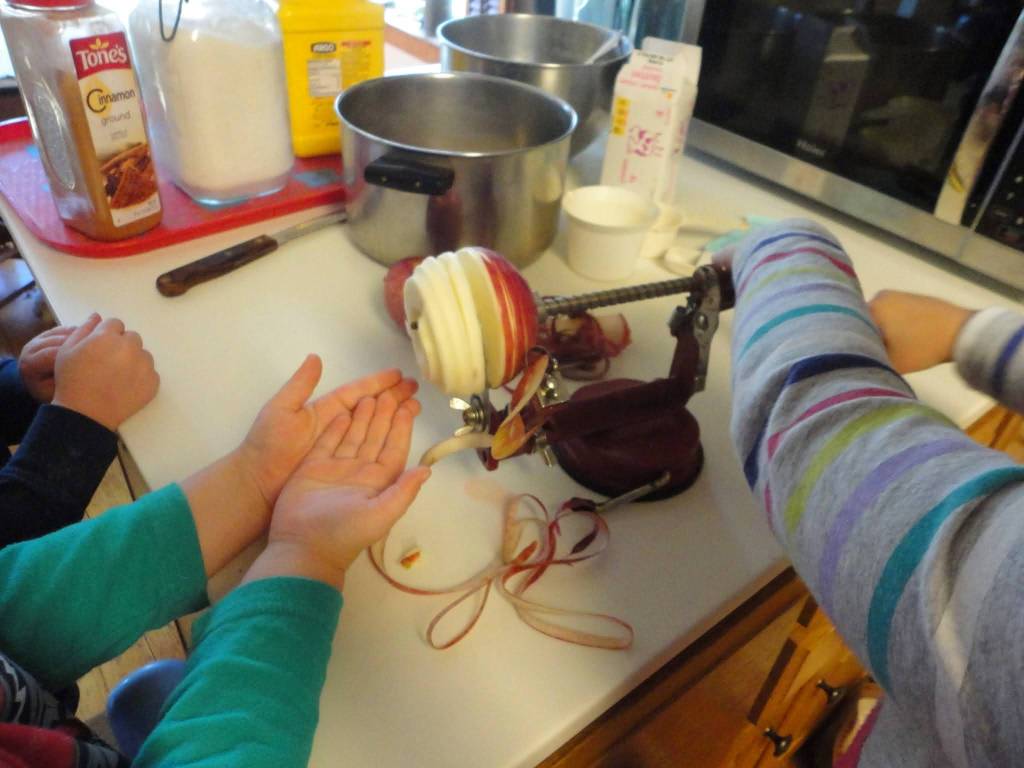
  • Cooking Equipment: Cooking helps children to learn concepts in math science, socialization,and expands language. Have measuring cups, mixing spoons, pots, pans, chopsticks, spatula, cookie cutters that can be explored while really cooking. 
  • Science Equipment:
    • Living things: plants and animals which can be adequately cared for plus cages, tanks, and accessories as appropriate 
    • Nature collections (e.g. cones, shells, rocks, wood slices) 
    • Sets of plastic wild animals, farm animals and dinosaurs 
    • Magnifying glasses 
    • Magnets and items made of metal 
    • Materials for Classifying, Ordering and Sequencing: Sets of toys which can be sorted or put in order.
    • Infants & Toddlers: nesting and stacking toys, sets of safe objects of various sizes and colours 
    • Preschool Up: objects to sort and classify (geometric shapes, small blocks of different types, buttons, cylinders, rocks, shells, marbles), sorting boxes/cans/ trays, materials to string (beads, pasta of various sizes and colours) 
    • Environmental Understanding: outdoor green space and also bringing it indoors with nature collections (such as shells, rocks and seeds), bird feeders, and wind chimes
  • Spatial Relationships: Children need to develop visual perception and recognition of objects as well as an understanding of spatial relationships. Toys in a variety of colours and shapes, pictures/posters/artwork at eye level, toy storage at eye level
    • Children at all ages need activities and materials that encourage creative endeavours such as music, art, movement, imaginative play, storytelling and construction. 
  • Art Equipment and Supplies: It is important to have enough art supplies for several children to use at one time. Have markers, crayons, sidewalk chalk, paint, finger paint supplies, paint smocks, gluing supplies, scissors, and watercolours.
  • Music, Dance and Movement: Instruments and dance props help children develop rhythm and creativity.
    • All Ages: simple rhythm instruments (rattles, drums, cymbals, tambourines, wooden blocks), selection of music from various cultures and tool to play it on, scarves
  • Dramatic Play: Dramatic play provides materials that allow children to fantasize and practice role-playing.
    • All Ages: multi-ethnic dolls and accessories (both genders), play kitchen (dishes, pots and pans, play foods, food containers), puppets, small world figures (doll house, farms, airports), and capes
  • Books and Storytelling: Books should include stories and people from various cultures and races, people with disabilities, and should show men and women, boys and girls, in a variety of roles.
    • All Ages: books, flannel board, puppets

Ok, now you’re thinking about everything you need and want within your space. The question is how you are going to get it all working together? Whether you are just starting up or well established, a proven way to discover best usage of your space is by drawing up a floor plan.

Make moveable paper pieces that are close to scale of your floor plan for all the larger pieces of equipment you need in the space. Now you can move these paper pieces around until you get the flow you want to meet the expected needs of the children you will be providing care for, as well as, your family. This is a handy tool to keep as you will often find your space needs to change some as the child in care also change developmentally.