From: Office of Child and Family Services (OCFS) Date: February 11, 2025
In 2024, statutory language in the state budget directed the Maine Department of Education(DOE) to transition responsibility for early childhood special education from Child Development Services (CDS) to school districts by July 1, 2028. During this 4-year transition period, there will be a change in responsibility for early childhood special education services from Child Development Services (CDS) to school districts, which are called school administrative units (SAUs) in Maine. Through this memo, the Office of Child and Family Services hopes to begin to answer questions you may have as a provider of early care and education services in Maine.
The goal throughout this transition is for preschool-aged children to receive their services in a quality early learning setting, called a least restrictive environment. That setting might be the early care and education program you lead.
What is the FAPE mandate in early childhood special education?
FAPE stands for Free Appropriate Public Education. Special education must be provided at public expense, under public supervision, at no cost to the parent. For 3–5-year-old children, early childhood education is provided in a least restrictive environment, and the child’s special education services deliver what is written in their individualized education program (IEP).
What is a Least Restrictive Environment (LRE)?
LREs are often early childhood education classrooms and programs where children with IEPs can learn alongside typically developing peers. This can include family child care programs, preschool classrooms in child care centers, YMCA preschool classrooms, Head Start preschoo classrooms, and preschool classrooms in K-12 schools.
During the 2024–2025 school year, a cohort of 18 SAUs has assumed responsibility for the provision of Free Appropriate Public Education (FAPE) for children 3-5 years old who are eligible for special education services. As the work with Cohort 1 continues, DOE will be supporting a second cohort for the 2025-2026 school year.
In the coming months, in partnership with DOE, OCFS will be sharing more information on this transition process and the important collaborative role of early care and education programs in local communities. Please sign up for notices from OCFS and DOE to receive updated information about this transition.
Child Care Affordability Program (CCAP) reimbursements will see the 2024 Maine Child Care Market Rate increase go into effect on July 6, 2024.
Here’s a detailed pdf showing county, full-time, part-time and half and quarter breakdowns: 2024 Market Rate effective July 6, 2024.
Reminder: Maine reimburses up to the market rate, so if your posted rates are below the market rate FCCAM encourages you to raise your posted rates accordingly.
Participation in subsidy programs is voluntary.
The release of the 2024 Maine Child Care Market Rate Survey has raised some questions from providers. FCCAM PLC has pull out information from the 142 page survey report that we felt would answer some of the questions/comments we are hearing.
FCCAM encouraged providers to complete the market rate survey to the best of their ability as any information above just what you charge would be helpful. A higher participation provides better data to OCFS . ~ The Federal government encourages states to include a cost of care analysis in the rate setting process. ~ Cost of care provides a better picture of cost and should increases the market rates.
All licensed child care facilities (834) and family child care providers (710) were invited to participate in the most recent survey. In total, 64.4 percent of providers participated in the survey, including 62.5 percent of child care facilities and 66.8 percent of family child care providers. Figure 1 illustrates participation rates by provider type and county.
Federal regulations do not dictate the specific rates paid by state child care subsidy programs. The Child Care Defense Fund (CCDF) does note the importance of state child care subsidy programs affording recipients access to a wide array of child care options.
Federal guidelines recommend, but do not require, that states establish subsidy payment rates at the 75th percentile of current market rates. Maine began setting its subsidy payment rates at the 75th percentile in 2017.
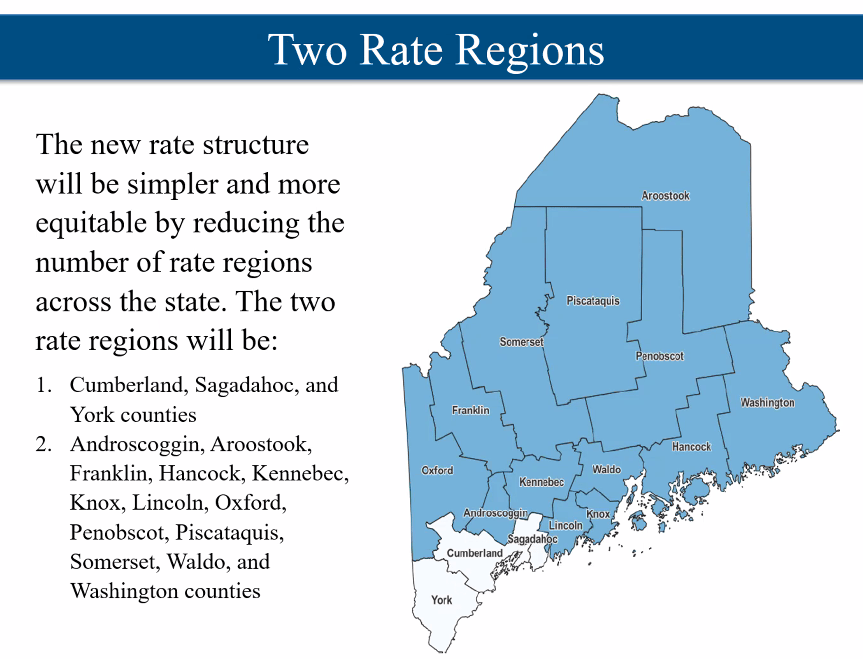
OCFS’s cost analysis showed little difference across Maine counties in the cost of providing care – 10% for family child care and 5% for child care centers. However, reimbursement rates in some parts of the state have been 45% lower than in others. OCFS could have moved to a flat state rate, but decided a shift to two regions would help to reduce geographic rate disparities without be to significant a change at this time.
For 2024, OCFS has adopted rate percentiles less than the 75th percentile for some payment rates. All rates reflect at least the 50th percentile, meaning that every payment rate covers the rate charged by at least half of the state’s providers for a given age group within a given region. If the selected rate benchmark would have resulted in a rate reduction, OCFS made a policy decision to maintain the existing rate in these instances.
This change from a flat 75% has led to some of the confusion for providers. Looking at the following chart found in the full report, the BOLD* is what the 2024 full-time rate will be for the listed region. The other percentiles shown are just for comparison.
The Child Care Defense Fund (CCDF) has a key goal to increase the number and percentage of low-income children in high-quality child care settings. Broad provider participation in Maine’s two child care subsidy programs – the CCAP and the TANF/ ASPIRE child care subsidy – is important to ensure enrolled families have access to a variety of child care options within their local area.
OCFS data indicates that 523 of the 834 child care facilities (63 percent) and 401 of the 710 family child care providers (56 percent) participate in the CCAP. This is a notable increase in the rate of participation since 2021. More than 90 percent of participating programs place strict enrollment caps of no more than 30 percent of total enrollment.
The survey asked providers that do not participate in the CCAP for their reasons. The primary reported barriers related to available capacity, low CCAP payment rates, and administrative rules and processes related to billing and reimbursement. OCFS has reported that they are working on new programs to facilitate billing, reimbursement, and support. Federal regulations on CCDF continue to change and OCFS is working to make changes to online management systems, reimbursement by enrollment vs attendance, and reimbursement at market rate. As these changes happen over the next year OCFS will keep providers informed.
Another change is child care staff can now participate in the subsidy program if they meet eligibility. Forms are now available for any qualifying staff.
Also beginning July 1, 2024, the income limit for CCAP will increase from 85 percent of the state’s median income (when adjusted for family size) to 125 percent of the state’s median income.
Additionally, recent legislation phases in a number of changes to the program by 2030, including further expanding eligibility to families earning up to 250 percent of the state’s median income, and limiting child care costs to no more than seven percent of a family’s income.
Hopefully this information will help you as you work your business budget, consider changes to your program, etc.
Please reach out if you have questions and we’ll see what we can find out.
Here’s the initial response: ANY type of emergency disaster drill counts…some options that could be practiced: shelter in place, lost child, simulated relocation (staff, NOT KIDS TRANSPORTED unsafely in cars), severe weather, unknown person/suspicious situation, coming inside due to an emergency, etc.
Here’s the clarification: The language of the Licensing Rule specifies a requirement for 2 evacuation drills in rule SECTION 14. ENVIRONMENT AND SAFETY /Q. Emergency preparedness plan / 2. The Provider must conduct an evacuation drill at least twice a year and the dates must be recorded and be available for review. (Same section for Facility Rule. Q/2 language: The Child Care Facility must conduct an evacuation drill at least twice a year and the dates must be recorded and be available for review. A simulated drill is acceptable.)
The key word is “evacuation“.
Shelter-in-place drills of any kind that do not include evacuation, do not meet the emergency drill needed for rule compliance.
Let’s look at this more:
You already do monthly fire drills with the smoke alarm.
You already have a running log for fire drills.
You need to add 2 noted Evacuation drills to that log.
Reminder: FCC Rule Section 5/A-5: A record of fire drills for the preceding three years must be available for inspection by the Department of Health and Human Services, the Department of Public Safety, State Fire Marshal’s Office, and local fire inspectors.
For fire drills, you use different exits.
Practice any of the other types of safety drills you think would support the children, such as shelter-in-place, reverse evacuation, medical emergency and lost child. Log any Safety Drill you practice.
For evacuation drill:
Simulate it: practice the steps to gather and leave. Use the language specific to evacuation vs fire.
As part of your Emergency Preparedness Plan you should have multiple alternate sites you could evacuate to. It is recommended to have one you can walk to. For a walking site you could actually gather and leave your premises.
You are not required to transport children off the premises. If you do transport children as part of your program, you can practice transporting as part of your drill. If you do not transport, you can practice what loading everyone into a vehicle would be like in an emergency. Simulating this does not put any child in harms way as your vehicle is not running at any point. You just practice loading in, sitting still, and unloading. You could then pretend you are at the safe site and what would you do there?
Discussions continue around legally providing care within your home in Maine. Within these discussions the resources provided to add to the discussion have not all been timely. Part of the mission of the Family Child Care Association of Maine is to provide timely and accurate information when questions are raised around family child care. In our effort to support all legally operating family child care providers in Maine we reached out to licensing to get an answer that is up to date. We also want to clearly state that FCCAM feels that all legal in-home care options are an important part of the child care system in Maine.
Here is the information we received:
A family child care provider can care for up to 2 children not living in the home and remain unlicensed. Maine Statute says a person can care for their own children living in their home and up to 2 children not living in their home for compensation and not be required to be licensed. Once an individual cares for 3 or more children not living in their home they require licensure.
FCCAM’s understanding is that an individual can have more than 2 children under contract for care, but only 2 can be receiving care within the home at the same time. For those looking at families wanting part-time care this can be important. This works the same way for licensed providers who provide care for clients needing part-time. It about juggling multiple children within the same careslot, so you are always within legal child/adult ratio.
Individuals providing care for up to 2 children are legal, but are not really labeled within the system by licensing unless they accept subsidy payments.
An individual providing care to up to 2 children not living in their home and accepting subsidy payments for one or both of those children, is referred to as a license-exempt (LE) provider by the state.
While the state does not label individual providers not accepting subsidy payments, FCCAM encourages any individual that is operating legally without needing to be licensed to refer to themselves as license-exempted. You are operating legally under state statutes. You are not licensed because you do not need to be. You are not operating illegally as an unlicensed provider caring for 3 or more children (not your own) at the same time.
FCCAM asked specifically about when the need for background checks and monitoring came into play for license-exempt providers.
Under the most recent Reauthorization of the Block Grant, a license-exempt (LE) provider that receives subsidy funds does have to complete Health and Safety training, needs to have background checks done and now needs to have a monitoring inspection annually to make sure they are meeting the basic health and safety requirements. There are more requirements now then there used to be, these are just a few of them.
An individual can reach out to the Child Care Subsidy Program to get a copy of the checklist that they send out to LE providers providing details of what is now required.
The Health and Safety training is a 6 hr training you can access through Maine Roads to Quality (MRTQ). You will need to be on the registry for that. You can find out how to access from this post.
Monitoring inspections are now posted for the public to see as part of the Child Care Choices site.





 fccamaine.com