
this training is recognized by FCCAM for 1 training hour ~
Biting is an instinctive behavior often seen in infants, toddlers, and 2-year olds. They bite in order to cope with a challenge or fulfill a need. Gaining self-control and developing problem-solving skills supports a child outgrowing the response of biting. It is unusual for a preschool age (3-5 year old) child to continue to bite. I recommend that a preschool age child be evaluated for developmental concerns if biting is a continual behavior. Data says 1 in 10 young children bite. Studies also indicate that between a third and a half of all toddlers in child care are bitten by another child. So while biting isn’t necessarily uncommon, it is still an upsetting behavior. Parents of a biter get embarrassed and worry that they may lose care. Providers fear parental anger, blame and even legal action. The parents of the bitten child get upset and worry about their child’s safety.
While not necessarily common biting becomes a challenging behavior when it causes harm to another. The purpose of this training is to share information about adapting your environment, communicating with all parents of children in your care and supporting your “biter”.
There are strategies that providers should be aware of that can be used for any challenging behavior at any age which also align with handling biting.:
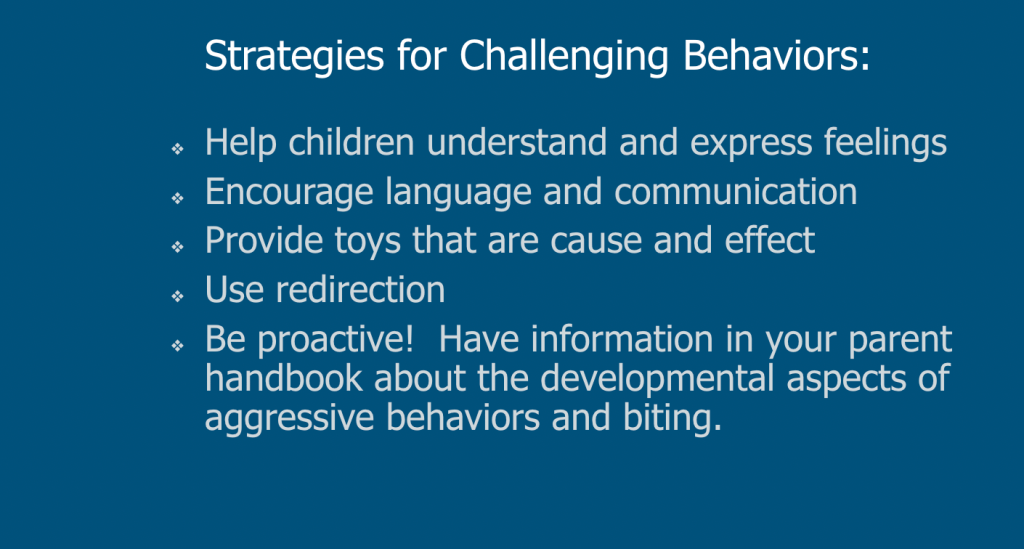
It’s good to have a general action plan that can help initially guide your actions with any challenging behavior that causes injury to themself or others. Later you can develop a more detailed and child specific plan.
After taking all the steps possible no child or provider should have to endure injury or pain for whatever the (known or unknown) reason for biting may be. With continual biting don’t hesitate to contact CDS for a developmental screening or make that tough decision to terminate care.
Now let’s break this training into sections to make it easier for you to not only read through, but to use in the future.
- “Biting”
- Assess Reasons for Biting
- Categories of Biting
- Action Plan
- Observation Builds Your Action Plan
“Biting”
It is important for biting to be addressed immediately when it occurs.
- You need to remain calm. A biting incident is scary for everyone.
- Deal with the safety of the children first. The behavior has occurred, you cannot change that now.
- the bitten child needs care
- the child that bit needs to also be safely removed from the situation so they can be calmed down and the behavior addressed.
Get on the child’s level, remain calm and use your voice and expression to show that biting is not acceptable. With eye contact, tell the child that bit something like: “Biting hurts. No biting.” You want it simple and direct. You can bring in additional language later. NEVER EVER bite the child that bit to show them it hurts. Biting them just models violence to them saying it’s acceptable.
Your primary concern is caring for the bitten child.
While beginning to comfort the bitten child you can point out to the child that bit how their behavior affected the other child: “You hurt her. She’s crying.” If language allows encourage the child who was bitten to tell the biter “You hurt me.” Some resources recommended that if developmentally appropriate, have the child who bit help the other child by getting the ice pack, etc. as a lesson in empathy and kindness. I never felt that it was an appropriate time to teach kindness and empathy. I also did not want any positive reinforcement of the biting, especially if the bite was for attention. Getting to help me might be perceived as a reward rather than a lesson in empathy and kindness.
Comfort
Comfort will look different for each child who is bitten. Some might need a physical hug, others need your lap, some just want to move on, and some really need distance to calm themselves.
- Remain calm getting on the child’s level.
- Example of comforting language: “That really hurt! You don’t like it when your friend bites your arm!” “I’m sorry you got bitten.”
- Cleanse the wound with mild soap and water.
- Provide an ice pack to reduce pain and swelling.
- If skin is broken immediately contact the parent as this strong of a bite should probably be seen by a health care professional.
- Always document a biting incident.
Labeling a “Biter”
While it’s important to not label, humiliate or isolate a child who bites, it is also hard to avoid calling or thinking of a child who has bitten a “biter”. It is important to not use the term where the child can hear it. Saying a child bit someone is different than calling them a “biter”. Ask other adults important to the child to also not use that term. Labeling children can actually lead to them taking on the identity assigned to them, which can intensify biting behavior rather than eliminate it. The behavior should be labeled, not the child.
Isolating the child who bit
Do not let a child who bit another head freely back into the group until you have been able to address what happened with them. I found it worked best to keep them near me while I comforted and provided any necessary first aid to the bitten child. This closeness allows me to be sure they do not bite another child, they do not go back to play and that they witness the hurt they caused. Once the bitten child was comforted and ready to rejoin the group or get back to their personal play, I took time to address the biting. I reinforce it’s not ok, it hurts, etc. Then, if language is present, I ask about what was happening that lead to the biting; what was the biter hoping to get; how the biter was feeling, etc. Questions really depend on the child’s language, but the answers need to be more than yes or no. You are looking for clues for building your plan to change the behavior and keep everyone safe. In a child care program, any plan for addressing biting includes the whole team – provider, staff, and parents.
Assess Reasons for Biting
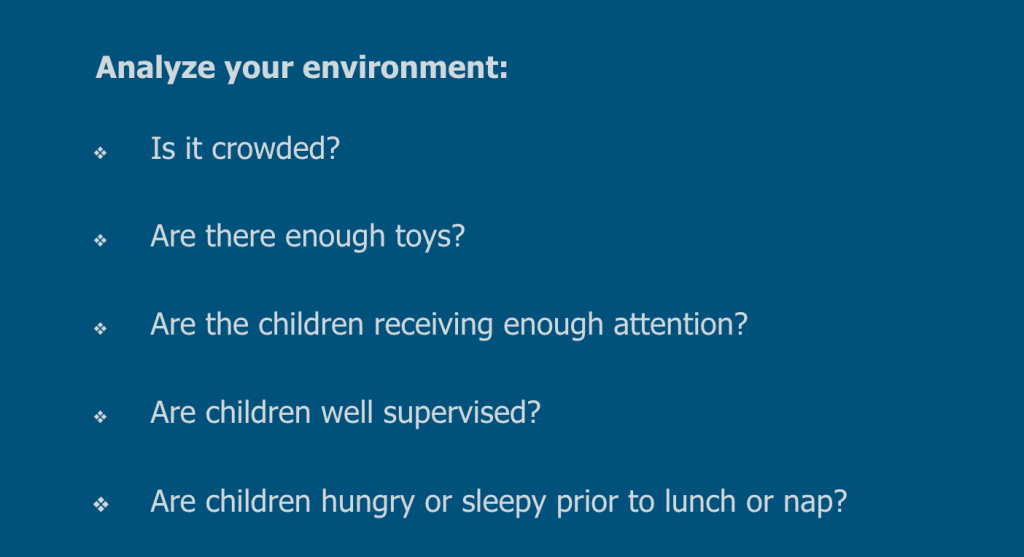
You will need time to assess/reflect on what was happening that possibly led to the bite. The time needed to assess what happened will be different if this is a first occurrence or repeating behavior. When you assess the situation you need to look at more than the child who bit. You need to assess the whole environment of your program. The environment includes both the physical setting and the emotional feeling of the space. It includes the personalities of every child present and the relationship between child and adults in the program. Following are some questions you might ask in your assessment.
Reasons for Biting
Infants learn about the world around them by exploring it with their hands, eyes, and mouths. Toddlers have many strong emotions that they are just learning to manage. It’s important to understand that infants and toddlers bite for many reasons, such as:
- Relieve pain from teething.
- Explore cause and effect (“What happens when I bite?”).
- Experience the sensation of biting/ oral stimulation.
- Satisfy a need for oral-motor stimulation.
- Imitate other children and adults.
- Feel strong and in control.
- Get attention.
- Act in self-defense.
- Communicate needs and desires, such as hunger or fatigue.
- Communicate or express difficult feelings, such as frustration, anger, confusion, or fear
Categories of Biting
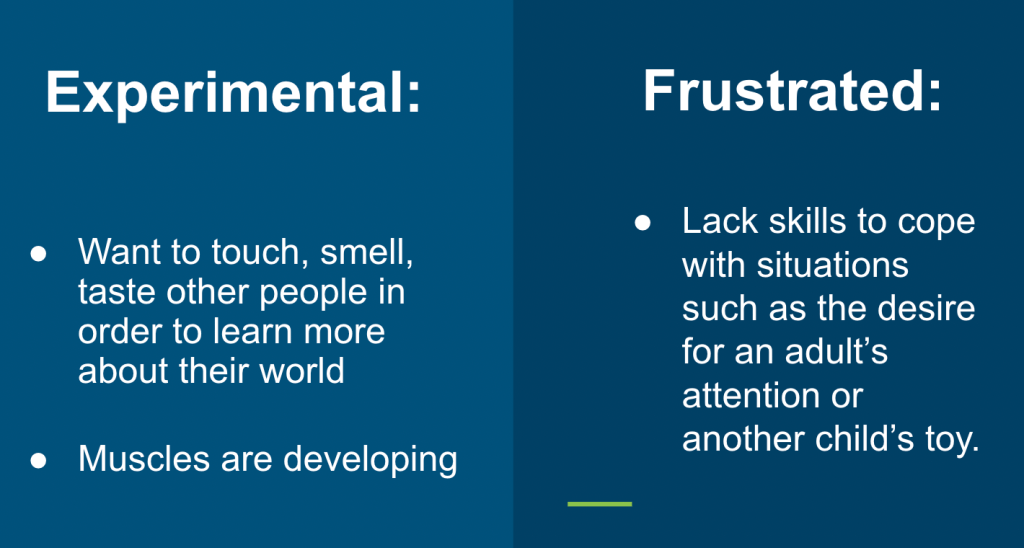
For this training we have grouped the reasons for biting into 4 categories. Other resources can use additional groups, but for most early education and care situations these four groups fit most situations and support communication with families.
Understanding the differences helped you find the support needed for the child and parents. As a team, we were able to identify various responses to be used to reduce/stop the incidents of biting whether at home or in care. All the adults that have regular contact with the child who is biting need to understand the reason this behavior is occurring and be committed to the solution and planned responses. Consistent responses are very important in stopping the unwanted behavior.
Experimental Biter: Infants and toddlers may experience discomfort when teething. A natural response by the child is to apply pressure to the gums by biting on things. Imitation is one of the primary ways children learn, so it is not uncommon for a child to bite after they have observed this behavior. Infants do not understand the difference between biting a toy and biting a person, until taught.
Strategies:
- If the child is using muscles in new ways, provide a variety of stimulating play materials (hard/soft, rough/smooth, heavy/light) and plan for plenty of active play indoors and outdoors.
- For teething pain offer appropriate things to chew on for relief, such as chewy foods, teething toys, or prefrozen toweling.
- Discourage play which involves “pretend” biting. Infants may not have a strong receptive language yet, but your tone and simple statement does convey it is not a good thing.
Frustrated Biter: Frustration does not always connect with anger. Think broader. Many times an infant or toddler bites when trying to interact with another child. At this age, the child has not yet developed the social skills to indicate that they want to play or even want help.
Strategies:
- Explain to the biter that biting hurts.
- Watch for signs of rising frustration.
- Continue development of language skills.
- If your child is frustrated in expressing his/her needs and wants, model a response that reflects what you believe they are trying to communicate.
- Help the child make connections with others.
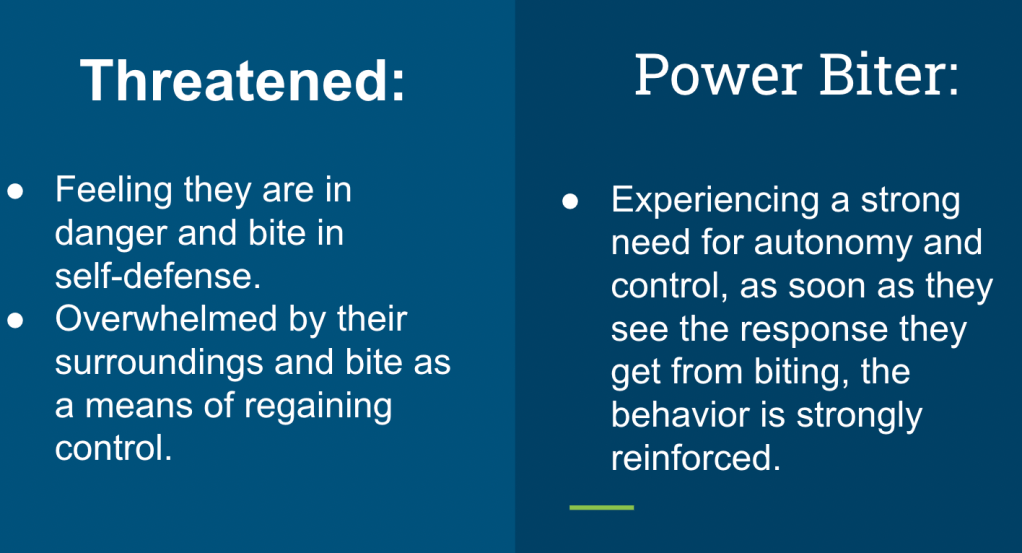
Threatened Biter: Young children can be threatened by new or changing situations such as a parent returning to work, a new baby, or parents separating. Help him or her talk about feelings even when he or she says things like “I hate my new baby.”
Strategies:
- Provide special nurturing in a warm and reassuring manner. *Note there are mixed views on using the term “safe”. This is especially important if the underlying situation may be abuse or neglect. There is a legal implication around “safe” that I do not clearly understand, but I did my best to stop using “safe”.
- The child may become threatened by situations such as newly separated parents, the death of a grandparent or a mother returning to work.
Power Biter: Toddlers have a strong need for independence and control. Very often the response children get from biting helps to satisfy this need.
Strategies:
- Provide positive attention when not biting to develop a sense of personal power without aggressive behavior involved.
- Provide opportunities to make age-appropriate choices and have some control.
- Give positive attention as new self-help skills and independence develop.
- Reinforce positive social behavior, such as sharing toys, or helping a friend.
“Biting Log“
A “Biting Log” can help you move beyond reaction mode and stop the biting before it repeats. Once you know what prompted the biting, you can step in to ease the tension or redirect an activity before it ends in a bite. Young children are sponges for learning, yet they have not developed strong problem-solving and social skills. These are important lessons for us to start early on with all children, but especially for those experiencing challenging behaviors.
A checklist of questions to use to make your “Biting Log” follows. Remember the purpose of the log is to be quickly used to collect data when assessing a biting situation:
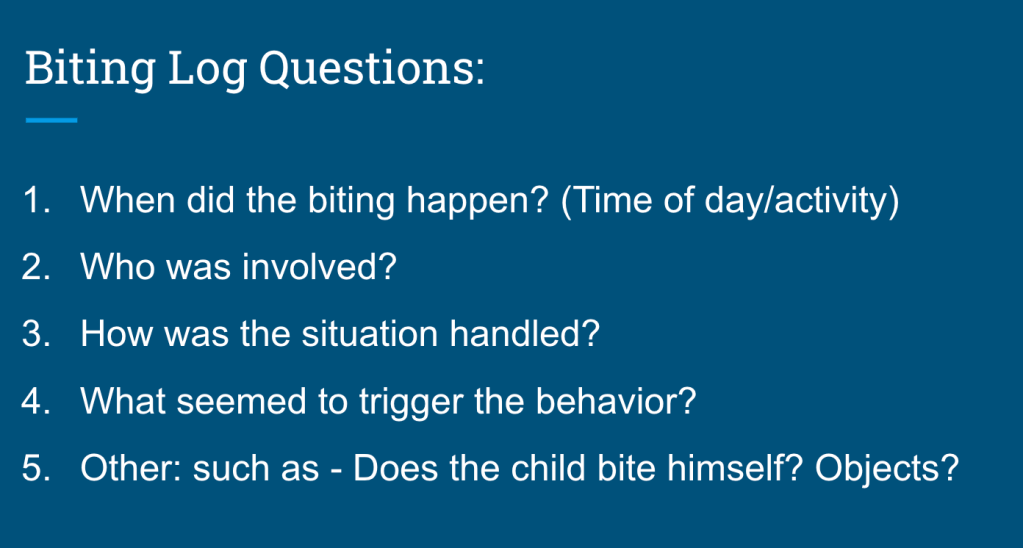
Following the “Biting Log” you might also find it beneficial to have a reflection checklist, which allows for reflection after the incident has been handled. Here are questions to consider:
- How was the situation handled?
- Why do you think the biting may be happening?
- What seemed to trigger the behavior?
- Does the child bite himself? Objects? Others/one in particular?
Action Plan
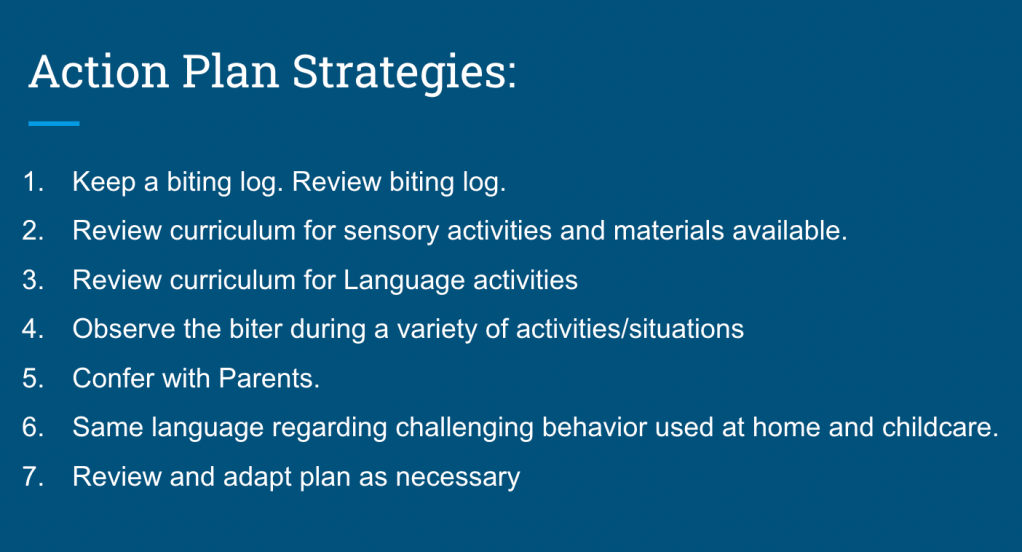
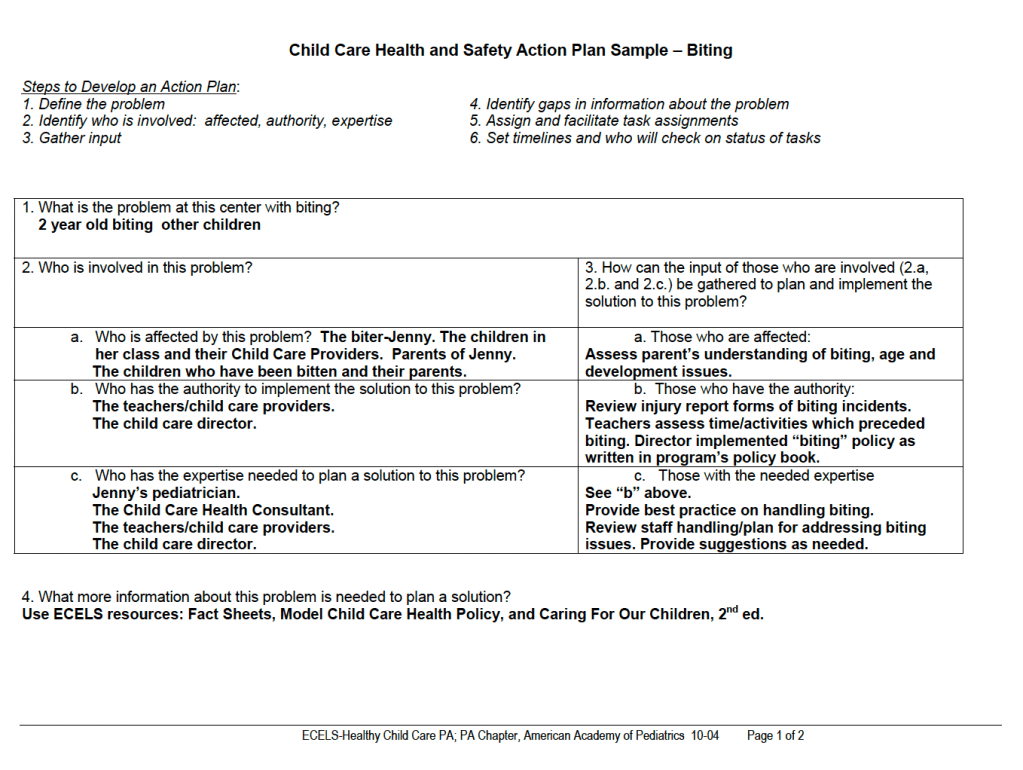
The answers to the assessing and reflection lead to development of an action plan.
Some biting situations do not require an involved action plan, but for a child with biting as a challenging behavior you will probably want an action plan. Review the action plan after every occurrence and make appropriate changes. The Action Plan might not work as hoped for, but remember it is an adaptable plan.
What to consider when developing your plan:
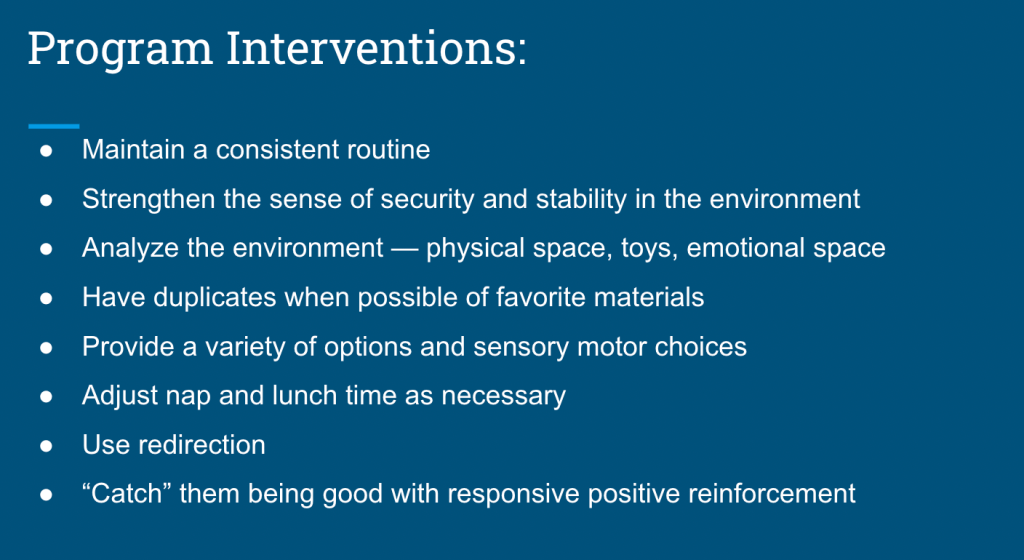
- Have age-appropriate expectations for the child’s behavior based on their current skills and abilities.
- Provide opportunities for the child to make choices and feel empowered.
- Make sure schedules, routines, and transitions are predictable and consistent.
- Offer activities and materials that allow the child to relax and release tension.
- Pay attention to signals. Stay close and step in if the child seems ready to bite.
- Suggest acceptable ways to express strong feelings. Help the child learn to communicate their wants and needs.
- Use a reminder system to help the child learn to express strong feelings with appropriate words and actions.
- Teach the child words for setting limits, such as “no,” “stop,” or “that’s mine.”
- Reinforce positive behavior by acknowledging the child’s appropriate words and actions.
- Provide items to bite that help the child learn what they can bite safely, without hurting anyone else.
- Offer foods with a variety of textures to meet the child’s sensory needs.
Used the action plan in communications with the other parents within the program reaffirming how you are addressing the situation and maintaining safety within the program. You do not need to include private information or specifics of the plan, but what the general process and steps will be as covered by the plan.
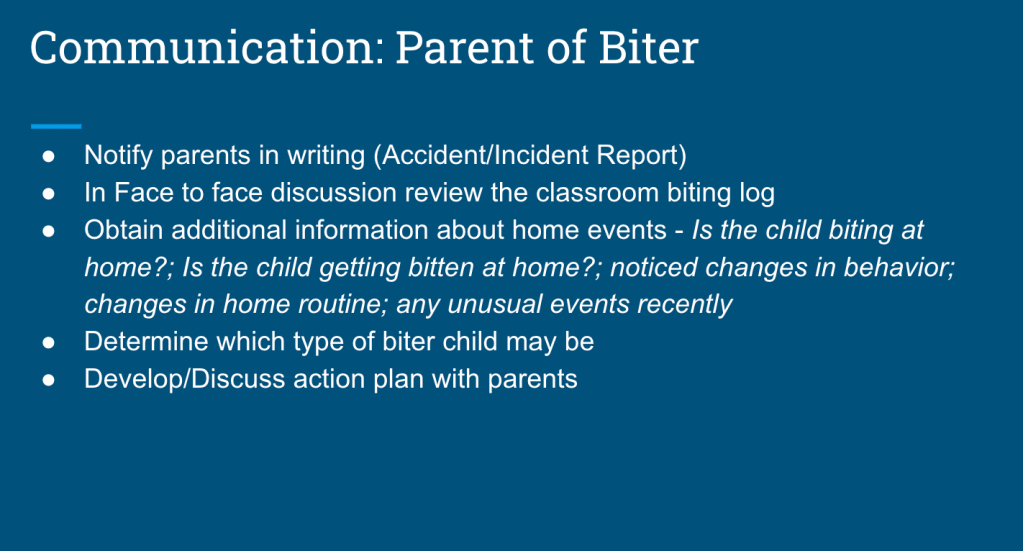
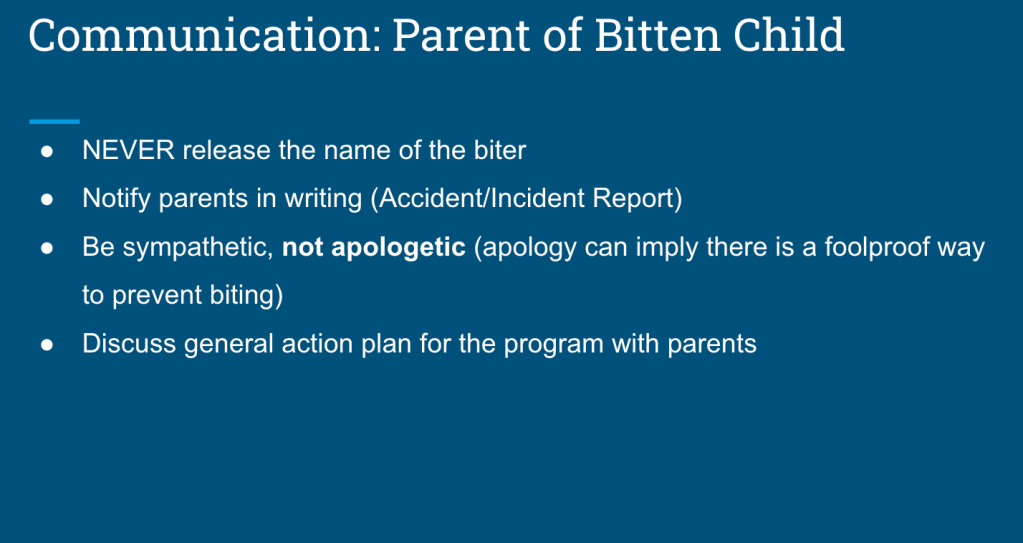
Communication around any strong biting situation needs to be confidential in that no names are shared, but it is important that all parents understand how you will be approaching the situation. Many parents do not realize that biting behavior is developmentally normal. You need to inform them of that and that you will use interventions targeted to the child and specific behavior. You will react swiftly. As developmentally appropriate, you will work on educating the children in the program on techniques to keep themselves safe. You will not force a child who bit and the child who was bitten to play together.
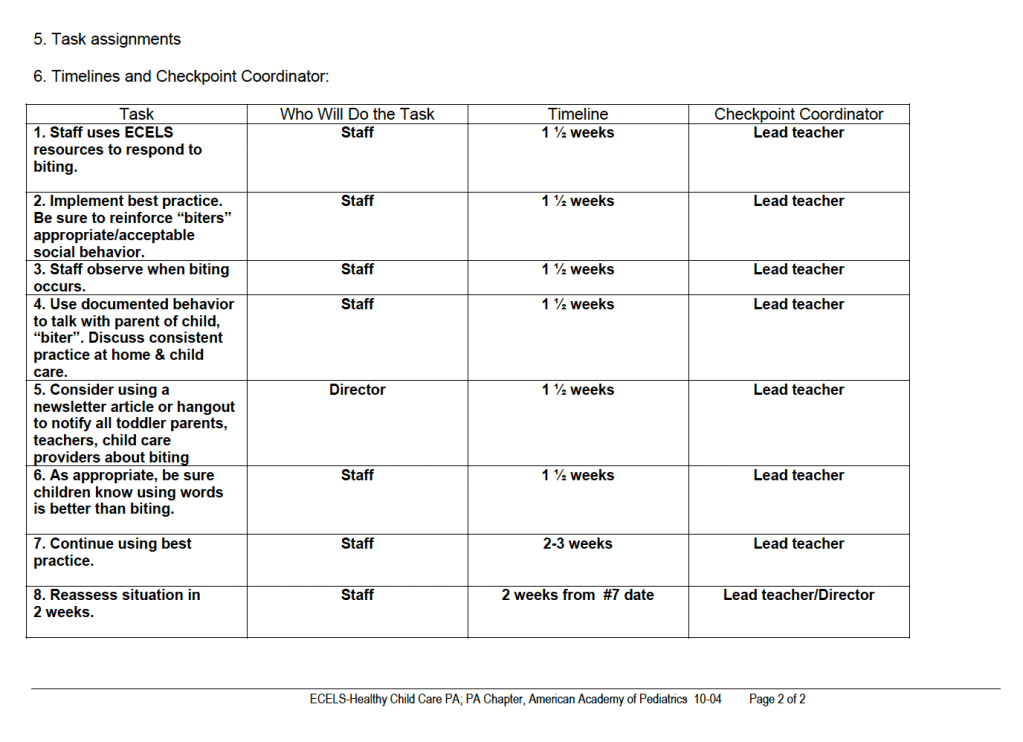
If you have staff, be very clear of responsibilities within the development of the Action Plan.
Communications
As stated previously, communication is important. Outside sharing the general action plan for the program, looked at how your communication needed to be different for the parents of the child that bit, the parents of the child that was bitten and generally to all program parents.
Additional Resources
Play Right—Don’t Bite! pdf from Illinois Early Learning
CCIDS Growing Ideas – Ouch! That hurts! – Biting
Observation Builds Your Action Plan
“Respectful observation” is a technique that matchs well with how children learn and as early childhood care and education professionals we can best support their development. “Respectful observation” reflects the belief that young children’s behaviors have purpose and meaning. If we see young children as having goals and intentions then it makes sense that we must attend to those behaviors as we work to support a child’s development. Here are some questions to be thinking about while observing children within your care in general, but defintely when working with challenging behaviors:
- Why does this child do what he does?
- What is he trying to communicate or accomplish?
- How should I respond to support this child?
Observation is the tool by which we can find answers to these questions, beyond what a child directly can verbalize to us. It provides opportunities to take a moment to determine a child’s goal or intention before responding. Observing from a respectful point of view helps us discover who children are as individuals, how they respond to other children and adults, what tasks are easy or hard for them, and how they convey wants and needs. This knowledge allows us to be responsive to each child’s interests and needs. It supports our efforts to develop action plans around challenging behaviors.
Answering the question – What motivates children? – becomes particularly important when behavior is challenging. You are looking for a pattern that provides the reason or goal behind the behavior.
- Infants’ and toddlers’ language skills are just developing, so their primary mode of communication is behavior. Even when they begin using words or sign language, their vocabulary for expressing themselves is still limited.
- They may be teething.
- They may want a toy that another child has.
- They may be hungry, tired, or even excited and happy.
- They may just want to know what an arm tastes or feels like in their mouth.
- They may be fascinated by the “cause-and-effect” reaction that follows after biting.
“Responsive Observation” has three steps:
- Watch
- Observe the child.
- Note what is happening, what causes the behavior, and what happens after the behavior occurs.
- Ask
- What does the behavior mean to the child? Family? Staff? Others?
- Adapt
- Decide what causes the child’s behavior and identify possible responses.
- Try out one of the responses.
- Watch the child’s reactions to see if a different response is needed.
Health and Safety Action Plan sample from ECELS:
 fccamaine.com