
Importance update from the Office of State Fire Marshal:
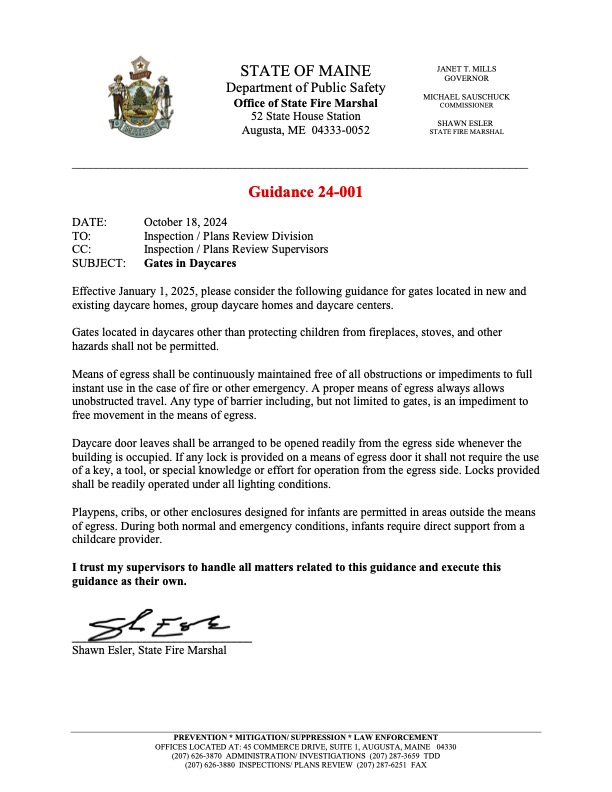
If you have any questions or concerns, or need any clarification or help understanding these requirements, please do not hesitate to contact the State Fire Marshal’s office where you can be connected with one of our inspectors who can provide you with assistance.
Here’s more information from Office of State Fire Marshal ~ from a November 25, 2024 memo:
The Office of the State Fire Marshal recently released internal guidance to its inspectors pertaining to gates and egress in daycares. This guidance was followed up with training and discussions related to this code interpretation. We were made aware this guidance was distributed by DHHS and prompted valid questions from daycare operators which led to this informational packet.
We have the utmost respect for our daycare operators and the challenges they face on a regular basis. We are committed to public education, sharing our experience with fire safety, and preventing death and injury from fire or other emergencies. Our daycare providers are stewards of safety, and we look forward to building strong working relationships with one another.
Why was this guidance issued? The Office of the State Fire Marshal is required to follow existing laws and regulations adopted through legislative action. During some routine daycare inspections gates, playpens, and other devices were observed preventing both adults and children from travelling to exit doors in an emergency.
We have further observed special locking arrangements on doors intending to provide safe exits. Since egress obstruction has been observed across the State in daycare and educational facilities, our office felt compelled to begin informing daycare providers of potential egress concerns.
Why January 1st, 2025? Due to the fact we cover the entire State of Maine, we issued guidance to address consistency across the State. Fair and consistent application of code is important to us. We chose this date as a goal to begin our educational campaign.
What specific laws/code prompted this guidance? Every component in the means of egress (an unobstructed route from any point in a building to a public way) must be operable by, and under the control of, the occupants attempting egress. One of the biggest obstacles a person can encounter, preventing them from free egress, is a locked door. Approaching a noncompliant locked door
unexpectedly and without the means necessary to operate it is an example of when egress becomes outside of an occupant’s control. This can hinder evacuation time and prevent occupants from getting to their point of safety. An unfortunate increase in hostile events, and similar threats has also increased the presence of security features on door assemblies within the means of egress to prevent unwanted entry. This added security, particularly where door assemblies to exit stairs and main egress routes are involved, could be disastrous in the event of a fire or other emergency. The provisions of NFPA 101, Life Safety Code, are aimed at preventing locked door assemblies in means of egress in the event of fire. The Code has attempted to balance this objective of free and unobstructed egress while also maintaining features that are essential to security within the building.

Are all gates not allowed? Our office recognizes the need for gates to protect children from hazard areas. Off limit areas of a home, separation of pets from children, guarding a stairway from access, keeping children away from appliances, stoves, or heating devices, etc. are all examples where gates may be utilized (when approved by inspector/AHJ). We trust that daycare providers can effectively identify and mitigate hazard areas.
What happens if an inspector finds a gate in the means of egress? In almost every situation or finding, our office works with our constituents to find a resolution to potential code concerns. We strive for voluntary compliance and our inspectors exercise discretion. Ninety nine percent of the time enforcement action is not required, and we consider that a last resort to address gross negligence.
Can I have a door with a lock to prevent children from going outside? You can always lock your doors from someone entering your facility. Locks can be installed to prevent unwanted entry from outside, but not on the egress side of the exit doors. Single Action Locks are ideal for daycares. There are a wide variety of locksets to choose from, so what makes these locks so great for daycare facilities? In short, it’s because these locks offer numerous safety benefits that allow for additional security while still being easy to operate. For one, there is no key or special knowledge/effort required to operate these locks when exiting a building. Even when the door is locked from the outside with a key, all you need to do is push the lever down or turn the knob to exit the building. The convenience of this feature is perfect for daycare doors that are frequently used. These
locksets are also equipped with an interconnect device between the knob/lever and the deadbolt, requiring a single action to unlock both simultaneously. It does not lock behind you, making it a quick, easy exit without locking anyone out.

Are there options other than gates to prevent children from accidentally exiting? There are many options including delayed egress locking arrangements, sensor releasing electronic locks, alarms,
and other devices recognized by fire code to assist. Depending on your situation, our inspectors can provide onsite recommendations. For example, if you have a fire alarm and sprinkler system, you can use delayed egress that sounds an alarm for 30 seconds before the door releases. We cannot, however, recommend brands or specific companies. Any installation of the delayed, sensor releasing locks or other devices will need to obtain approval or possibly permitting prior to installation. Half doors are an acceptable replacement for a gate used in an egress path. They are on hinges, swing, and have a door handle.
Can I have a playpen, crib and other items designed to contain children? Of course, play pens, cribs and other items made for children’s use, are to be used for their design and age group. In most cases this would apply to infants. In emergencies, the children would require rescue from staff. We ask that they are not placed in front of a doorway, corridor, hallway, escape window, or exit path-and should be approved by inspector or supervisor. If you are putting up permanent structures and walls, please contact our office to see if you need a construction permit for daycare centers (more than 12 children).
Can I have a gate or fenced outside area? Of course, the intent of our guidance was to primarily address obstructions inside a daycare home or center. The outside exit path outside should be clear of obstructions, including snow, so in the event of a fire or major emergency everyone can keep a safe distance for the arrival of emergency services. The exterior gates would also need to comply with egress requirements.
Here’s some additional info about egress points. Here’s the full page: https://www.maine.gov/dps/fmo/sites/maine.gov.dps.fmo/files/inline-files/childcarefacility_fixed.pdf?.
Day care facilities are divided into three general groups according to the number of children or adults which are cared for at one given time.
- Day care centers- offering care to more than 12 children or adults
- Group day care homes- offering care to from 7 to 12 children or adults
- Day care home- offering care to 6 or fewer children or adults

The Department of Public Safety does not recognize the act of removing the sashes of a double hung window to achieve the minimum of 5.7 square feet of clear opening. The method used by this
department in measuring the clear opening of a window is illustrated below. This method uses the
opening when the widow is in its normal open position.
The requirements for a secondary means of escape from all rooms used for day-care purposes still
remains.
Smoke detectors must be installed in all areas used for day-care and in all napping rooms used by the day-care clients. In new group day care homes smoke detectors must be installed on all floor levels of the building. All smoke detectors must be supplied power by the building electrical system. In existing day care facilities one required smoke detector must be supplied by the building electrical system. Again in all existing day care facilities, all floor levels must have a smoke detector. All single station smoke detectors, (detectors not interconnected with other detectors or connected to a fire alarm panel) must be tested on a monthly basis and a record kept at the facility. New smoke detectors are available which are generally powered by the building electrical service and also have a battery contained within which will keep them effective even during a power outage. All new installation of smoke detectors requires that they are powered by the building electrical supply and must have a battery backup.
If basements are used for day care purposes an exit with a normal side hinged door (not a bulkhead) must be provided to allow exiting directly to the outside. Remember, all rooms used for day care purposes must have a same egress window or door as required for all other floor levels. Normal basement windows installed during construction are most often too small to meet these requirements.
Exceptions to fire codes exist when fully sprinkler protected. Many new homes in the State of Maine are being constructed with a residential sprinkler system installed at the time of construction. These residential sprinklers systems have been proven in many other states to be life safety systems.

 fccamaine.com