
Child Care Affordability Program (CCAP) reimbursements will see the 2024 Maine Child Care Market Rate increase go into effect on July 6, 2024.
Here’s a detailed pdf showing county, full-time, part-time and half and quarter breakdowns: 2024 Market Rate effective July 6, 2024.
Reminder: Maine reimburses up to the market rate, so if your posted rates are below the market rate FCCAM encourages you to raise your posted rates accordingly.
Participation in subsidy programs is voluntary.
The release of the 2024 Maine Child Care Market Rate Survey has raised some questions from providers. FCCAM PLC has pull out information from the 142 page survey report that we felt would answer some of the questions/comments we are hearing.
FCCAM encouraged providers to complete the market rate survey to the best of their ability as any information above just what you charge would be helpful. A higher participation provides better data to OCFS . ~ The Federal government encourages states to include a cost of care analysis in the rate setting process. ~ Cost of care provides a better picture of cost and should increases the market rates.
All licensed child care facilities (834) and family child care providers (710) were invited to participate in the most recent survey. In total, 64.4 percent of providers participated in the survey, including 62.5 percent of child care facilities and 66.8 percent of family child care providers. Figure 1 illustrates participation rates by provider type and county.

Federal regulations do not dictate the specific rates paid by state child care subsidy programs. The Child Care Defense Fund (CCDF) does note the importance of state child care subsidy programs affording recipients access to a wide array of child care options.
Federal guidelines recommend, but do not require, that states establish subsidy payment rates at the 75th percentile of current market rates. Maine began setting its subsidy payment rates at the 75th percentile in 2017.
OCFS’s cost analysis showed little difference across Maine counties in the cost of providing care – 10% for family child care and 5% for child care centers. However, reimbursement rates in some parts of the state have been 45% lower than in others. OCFS could have moved to a flat state rate, but decided a shift to two regions would help to reduce geographic rate disparities without be to significant a change at this time.
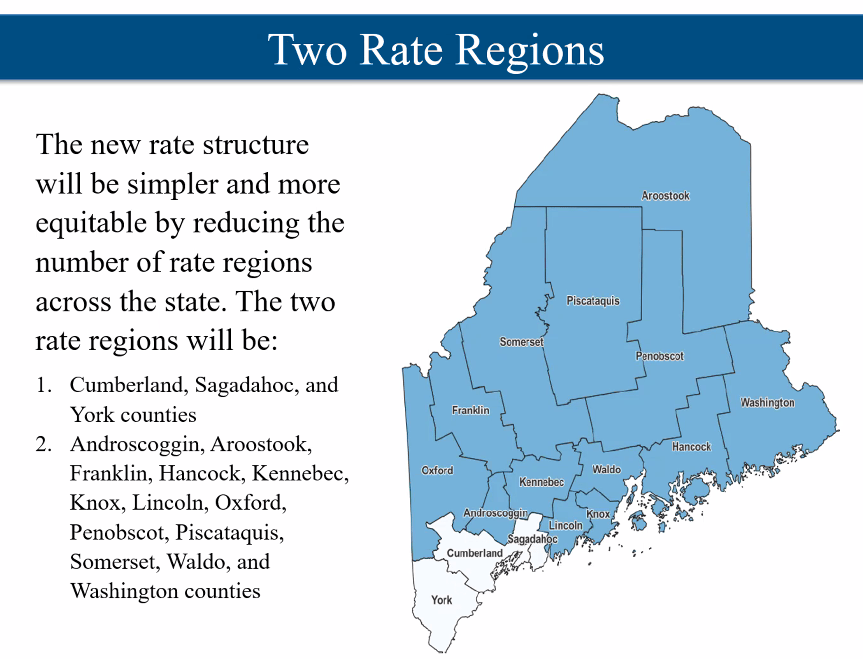
For 2024, OCFS has adopted rate percentiles less than the 75th percentile for some payment rates. All rates reflect at least the 50th percentile, meaning that every payment rate covers the rate charged by at least half of the state’s providers for a given age group within a given region. If the selected rate benchmark would have resulted in a rate reduction, OCFS made a policy decision to maintain the existing rate in these instances.
This change from a flat 75% has led to some of the confusion for providers. Looking at the following chart found in the full report, the BOLD* is what the 2024 full-time rate will be for the listed region. The other percentiles shown are just for comparison.

The Child Care Defense Fund (CCDF) has a key goal to increase the number and percentage of low-income children in high-quality child care settings. Broad provider participation in Maine’s two child care subsidy programs – the CCAP and the TANF/ ASPIRE child care subsidy – is important to ensure enrolled families have access to a variety of child care options within their local area.
OCFS data indicates that 523 of the 834 child care facilities (63 percent) and 401 of the 710 family child care providers (56 percent) participate in the CCAP. This is a notable increase in the rate of participation since 2021. More than 90 percent of participating programs place strict enrollment caps of no more than 30 percent of total enrollment.


The survey asked providers that do not participate in the CCAP for their reasons. The primary reported barriers related to available capacity, low CCAP payment rates, and administrative rules and processes related to billing and reimbursement. OCFS has reported that they are working on new programs to facilitate billing, reimbursement, and support. Federal regulations on CCDF continue to change and OCFS is working to make changes to online management systems, reimbursement by enrollment vs attendance, and reimbursement at market rate. As these changes happen over the next year OCFS will keep providers informed.
Another change is child care staff can now participate in the subsidy program if they meet eligibility. Forms are now available for any qualifying staff.
Also beginning July 1, 2024, the income limit for CCAP will increase from 85 percent of the state’s median income (when adjusted for family size) to 125 percent of the state’s median income.
Additionally, recent legislation phases in a number of changes to the program by 2030, including further expanding eligibility to families earning up to 250 percent of the state’s median income, and limiting child care costs to no more than seven percent of a family’s income.
Hopefully this information will help you as you work your business budget, consider changes to your program, etc.
Please reach out if you have questions and we’ll see what we can find out.
 fccamaine.com