From: Office of Child and Family Services (OCFS) Date: February 11, 2025
In 2024, statutory language in the state budget directed the Maine Department of Education(DOE) to transition responsibility for early childhood special education from Child Development Services (CDS) to school districts by July 1, 2028. During this 4-year transition period, there will be a change in responsibility for early childhood special education services from Child Development Services (CDS) to school districts, which are called school administrative units (SAUs) in Maine. Through this memo, the Office of Child and Family Services hopes to begin to answer questions you may have as a provider of early care and education services in Maine.
The goal throughout this transition is for preschool-aged children to receive their services in a quality early learning setting, called a least restrictive environment. That setting might be the early care and education program you lead.
What is the FAPE mandate in early childhood special education?
FAPE stands for Free Appropriate Public Education. Special education must be provided at public expense, under public supervision, at no cost to the parent. For 3–5-year-old children, early childhood education is provided in a least restrictive environment, and the child’s special education services deliver what is written in their individualized education program (IEP).
What is a Least Restrictive Environment (LRE)?
LREs are often early childhood education classrooms and programs where children with IEPs can learn alongside typically developing peers. This can include family child care programs, preschool classrooms in child care centers, YMCA preschool classrooms, Head Start preschoo classrooms, and preschool classrooms in K-12 schools.
During the 2024–2025 school year, a cohort of 18 SAUs has assumed responsibility for the provision of Free Appropriate Public Education (FAPE) for children 3-5 years old who are eligible for special education services. As the work with Cohort 1 continues, DOE will be supporting a second cohort for the 2025-2026 school year.
In the coming months, in partnership with DOE, OCFS will be sharing more information on this transition process and the important collaborative role of early care and education programs in local communities. Please sign up for notices from OCFS and DOE to receive updated information about this transition.
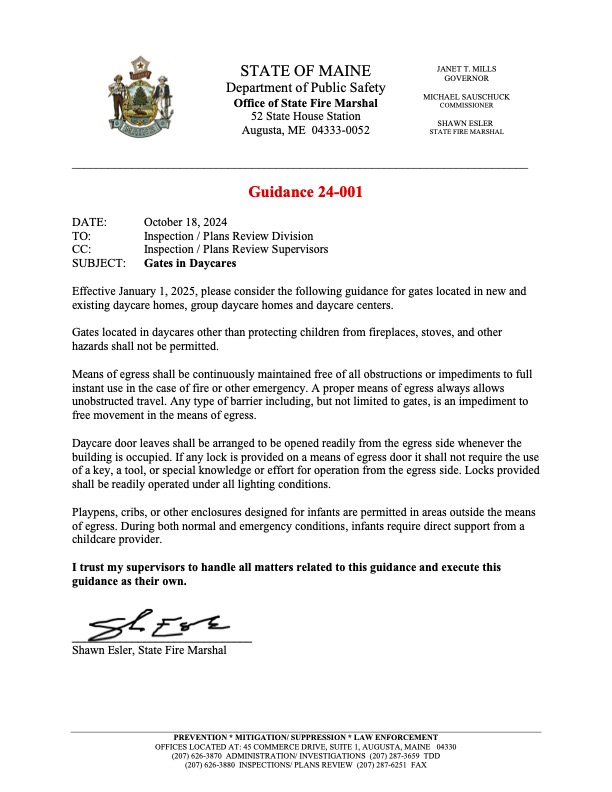
Importance update from the Office of State Fire Marshal:
If you have any questions or concerns, or need any clarification or help understanding these requirements, please do not hesitate to contact the State Fire Marshal’s office where you can be connected with one of our inspectors who can provide you with assistance.
Here’s more information from Office of State Fire Marshal ~ from a November 25, 2024 memo: The Office of the State Fire Marshal recently released internal guidance to its inspectors pertaining to gates and egress in daycares. This guidance was followed up with training and discussions related to this code interpretation. We were made aware this guidance was distributed by DHHS and prompted valid questions from daycare operators which led to this informational packet. We have the utmost respect for our daycare operators and the challenges they face on a regular basis. We are committed to public education, sharing our experience with fire safety, and preventing death and injury from fire or other emergencies. Our daycare providers are stewards of safety, and we look forward to building strong working relationships with one another.
Why was this guidance issued? The Office of the State Fire Marshal is required to follow existing laws and regulations adopted through legislative action. During some routine daycare inspections gates, playpens, and other devices were observed preventing both adults and children from travelling to exit doors in an emergency. We have further observed special locking arrangements on doors intending to provide safe exits. Since egress obstruction has been observed across the State in daycare and educational facilities, our office felt compelled to begin informing daycare providers of potential egress concerns.
Why January 1st, 2025? Due to the fact we cover the entire State of Maine, we issued guidance to address consistency across the State. Fair and consistent application of code is important to us. We chose this date as a goal to begin our educational campaign.
What specific laws/code prompted this guidance? Every component in the means of egress (an unobstructed route from any point in a building to a public way) must be operable by, and under the control of, the occupants attempting egress. One of the biggest obstacles a person can encounter, preventing them from free egress, is a locked door. Approaching a noncompliant locked door unexpectedly and without the means necessary to operate it is an example of when egress becomes outside of an occupant’s control. This can hinder evacuation time and prevent occupants from getting to their point of safety. An unfortunate increase in hostile events, and similar threats has also increased the presence of security features on door assemblies within the means of egress to prevent unwanted entry. This added security, particularly where door assemblies to exit stairs and main egress routes are involved, could be disastrous in the event of a fire or other emergency. The provisions of NFPA 101, Life Safety Code, are aimed at preventing locked door assemblies in means of egress in the event of fire. The Code has attempted to balance this objective of free and unobstructed egress while also maintaining features that are essential to security within the building.
Are all gates not allowed? Our office recognizes the need for gates to protect children from hazard areas. Off limit areas of a home, separation of pets from children, guarding a stairway from access, keeping children away from appliances, stoves, or heating devices, etc. are all examples where gates may be utilized (when approved by inspector/AHJ). We trust that daycare providers can effectively identify and mitigate hazard areas. What happens if an inspector finds a gate in the means of egress? In almost every situation or finding, our office works with our constituents to find a resolution to potential code concerns. We strive for voluntary compliance and our inspectors exercise discretion. Ninety nine percent of the time enforcement action is not required, and we consider that a last resort to address gross negligence. Can I have a door with a lock to prevent children from going outside? You can always lock your doors from someone entering your facility. Locks can be installed to prevent unwanted entry from outside, but not on the egress side of the exit doors. Single Action Locks are ideal for daycares. There are a wide variety of locksets to choose from, so what makes these locks so great for daycare facilities? In short, it’s because these locks offer numerous safety benefits that allow for additional security while still being easy to operate. For one, there is no key or special knowledge/effort required to operate these locks when exiting a building. Even when the door is locked from the outside with a key, all you need to do is push the lever down or turn the knob to exit the building. The convenience of this feature is perfect for daycare doors that are frequently used. These locksets are also equipped with an interconnect device between the knob/lever and the deadbolt, requiring a single action to unlock both simultaneously. It does not lock behind you, making it a quick, easy exit without locking anyone out.
Are there options other than gates to prevent children from accidentally exiting? There are many options including delayed egress locking arrangements, sensor releasing electronic locks, alarms, and other devices recognized by fire code to assist. Depending on your situation, our inspectors can provide onsite recommendations. For example, if you have a fire alarm and sprinkler system, you can use delayed egress that sounds an alarm for 30 seconds before the door releases. We cannot, however, recommend brands or specific companies. Any installation of the delayed, sensor releasing locks or other devices will need to obtain approval or possibly permitting prior to installation. Half doors are an acceptable replacement for a gate used in an egress path. They are on hinges, swing, and have a door handle. Can I have a playpen, crib and other items designed to contain children? Of course, play pens, cribs and other items made for children’s use, are to be used for their design and age group. In most cases this would apply to infants. In emergencies, the children would require rescue from staff. We ask that they are not placed in front of a doorway, corridor, hallway, escape window, or exit path-and should be approved by inspector or supervisor. If you are putting up permanent structures and walls, please contact our office to see if you need a construction permit for daycare centers (more than 12 children). Can I have a gate or fenced outside area? Of course, the intent of our guidance was to primarily address obstructions inside a daycare home or center. The outside exit path outside should be clear of obstructions, including snow, so in the event of a fire or major emergency everyone can keep a safe distance for the arrival of emergency services. The exterior gates would also need to comply with egress requirements.
Day care facilities are divided into three general groups according to the number of children or adults which are cared for at one given time.
Day care centers- offering care to more than 12 children or adults
Group day care homes- offering care to from 7 to 12 children or adults
Day care home- offering care to 6 or fewer children or adults
The Department of Public Safety does not recognize the act of removing the sashes of a double hung window to achieve the minimum of 5.7 square feet of clear opening. The method used by this department in measuring the clear opening of a window is illustrated below. This method uses the opening when the widow is in its normal open position.
The requirements for a secondary means of escape from all rooms used for day-care purposes still remains.
Smoke detectors must be installed in all areas used for day-care and in all napping rooms used by the day-care clients. In new group day care homes smoke detectors must be installed on all floor levels of the building. All smoke detectors must be supplied power by the building electrical system. In existing day care facilities one required smoke detector must be supplied by the building electrical system. Again in all existing day care facilities, all floor levels must have a smoke detector. All single station smoke detectors, (detectors not interconnected with other detectors or connected to a fire alarm panel) must be tested on a monthly basis and a record kept at the facility. New smoke detectors are available which are generally powered by the building electrical service and also have a battery contained within which will keep them effective even during a power outage. All new installation of smoke detectors requires that they are powered by the building electrical supply and must have a battery backup.
If basements are used for day care purposes an exit with a normal side hinged door (not a bulkhead) must be provided to allow exiting directly to the outside. Remember, all rooms used for day care purposes must have a same egress window or door as required for all other floor levels. Normal basement windows installed during construction are most often too small to meet these requirements.
Exceptions to fire codes exist when fully sprinkler protected. Many new homes in the State of Maine are being constructed with a residential sprinkler system installed at the time of construction. These residential sprinklers systems have been proven in many other states to be life safety systems.
FCCAM PLC has a new section in the sidebar of the website that allows for providers to ask questions and the PLC will reach out to find the answers. When appropriate we will share the answer to the wider community and pass the question along to partner organizations to inform them of an issue.
We recently had a provider reach out about their responsibility to release information they recorded around a question of possible child abuse and neglect.
Here’s the general situation information we received:
A question of possible child abuse and neglect at home occured. Provider followed their policy and wrote an incident report and reported it to the hotline number. Child is no longer in the program. Parent sent an email requesting all of the information from the child’s records.
Question: Does the incident report need to be included with the other material in the child’s record?
The PLC reached out to Licensing Supervisors. Following are the keys points from our conversations with them.
FCC and Facility Licensing Rules require Child Abuse and Neglect reports to be kept separate from Children’s Records.
Being maintained separately means they do not need to be released as part of a Parent’s request for their Child’s record.
If for some reason a program isn’t keeping CPS reports in a separate file they should going forward.
Here’s the Licensing Rule language:
A-C. Record Management/ Section 5. Record Management and Retention
A. Record management. Providers must comply with the following:
4. Maintain a separate record of all reports of alleged Child Abuse or Neglect made in accordance with 22 MRS §4011-A.
A-D. Section 6 / Reporting Requirements
B. Mandatory report of suspected Abuse or Neglect. Any provider suspecting Abuse or Neglect must immediately report this information to Child Protective Intake Services, 1-800-452-1999, TTY 1-800- 963-9490 which is staffed 24 hours a day, 7 days a week. 1. The provider must maintain documentation, not maintained in the Child’s record, that a report has been made.
2. All reporting of suspected Child Abuse or Neglect, and serious injuries of a Child who is under six months of age or otherwise non-ambulatory, must comply with 22 MRS §4011-A.
FCCAM encourages providers to review their Mandated Reporter policy and check when they completed their last Mandated Reporter training. Renewal is required every 4 years.
Child Care Affordability Program (CCAP) reimbursements will see the 2024 Maine Child Care Market Rate increase go into effect on July 6, 2024.
Here’s a detailed pdf showing county, full-time, part-time and half and quarter breakdowns: 2024 Market Rate effective July 6, 2024.
Reminder: Maine reimburses up to the market rate, so if your posted rates are below the market rate FCCAM encourages you to raise your posted rates accordingly.
Participation in subsidy programs is voluntary.
The release of the 2024 Maine Child Care Market Rate Survey has raised some questions from providers. FCCAM PLC has pull out information from the 142 page survey report that we felt would answer some of the questions/comments we are hearing.
FCCAM encouraged providers to complete the market rate survey to the best of their ability as any information above just what you charge would be helpful. A higher participation provides better data to OCFS . ~ The Federal government encourages states to include a cost of care analysis in the rate setting process. ~ Cost of care provides a better picture of cost and should increases the market rates.
All licensed child care facilities (834) and family child care providers (710) were invited to participate in the most recent survey. In total, 64.4 percent of providers participated in the survey, including 62.5 percent of child care facilities and 66.8 percent of family child care providers. Figure 1 illustrates participation rates by provider type and county.
Federal regulations do not dictate the specific rates paid by state child care subsidy programs. The Child Care Defense Fund (CCDF) does note the importance of state child care subsidy programs affording recipients access to a wide array of child care options.
Federal guidelines recommend, but do not require, that states establish subsidy payment rates at the 75th percentile of current market rates. Maine began setting its subsidy payment rates at the 75th percentile in 2017.
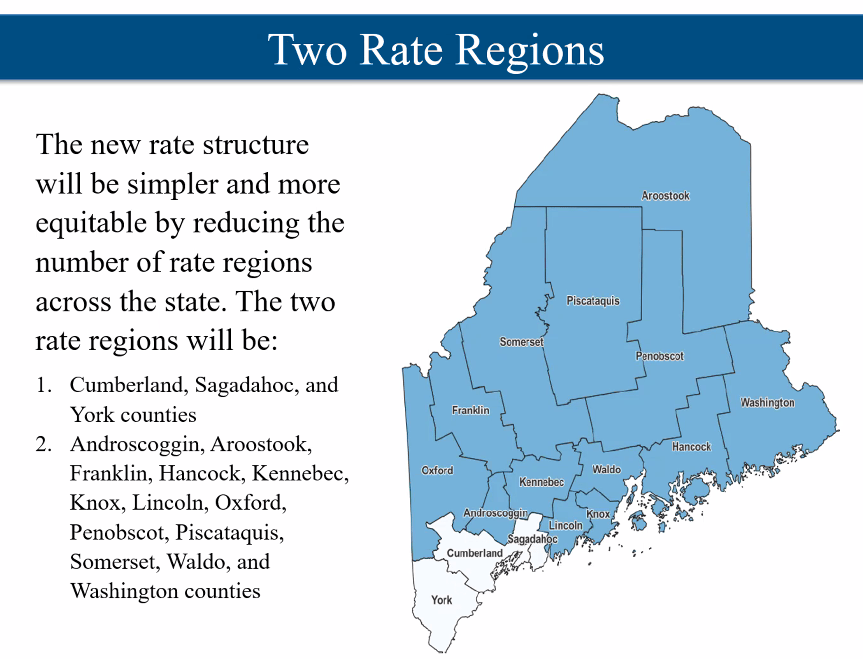
OCFS’s cost analysis showed little difference across Maine counties in the cost of providing care – 10% for family child care and 5% for child care centers. However, reimbursement rates in some parts of the state have been 45% lower than in others. OCFS could have moved to a flat state rate, but decided a shift to two regions would help to reduce geographic rate disparities without be to significant a change at this time.
For 2024, OCFS has adopted rate percentiles less than the 75th percentile for some payment rates. All rates reflect at least the 50th percentile, meaning that every payment rate covers the rate charged by at least half of the state’s providers for a given age group within a given region. If the selected rate benchmark would have resulted in a rate reduction, OCFS made a policy decision to maintain the existing rate in these instances.
This change from a flat 75% has led to some of the confusion for providers. Looking at the following chart found in the full report, the BOLD* is what the 2024 full-time rate will be for the listed region. The other percentiles shown are just for comparison.
The Child Care Defense Fund (CCDF) has a key goal to increase the number and percentage of low-income children in high-quality child care settings. Broad provider participation in Maine’s two child care subsidy programs – the CCAP and the TANF/ ASPIRE child care subsidy – is important to ensure enrolled families have access to a variety of child care options within their local area.
OCFS data indicates that 523 of the 834 child care facilities (63 percent) and 401 of the 710 family child care providers (56 percent) participate in the CCAP. This is a notable increase in the rate of participation since 2021. More than 90 percent of participating programs place strict enrollment caps of no more than 30 percent of total enrollment.
The survey asked providers that do not participate in the CCAP for their reasons. The primary reported barriers related to available capacity, low CCAP payment rates, and administrative rules and processes related to billing and reimbursement. OCFS has reported that they are working on new programs to facilitate billing, reimbursement, and support. Federal regulations on CCDF continue to change and OCFS is working to make changes to online management systems, reimbursement by enrollment vs attendance, and reimbursement at market rate. As these changes happen over the next year OCFS will keep providers informed.
Another change is child care staff can now participate in the subsidy program if they meet eligibility. Forms are now available for any qualifying staff.
Also beginning July 1, 2024, the income limit for CCAP will increase from 85 percent of the state’s median income (when adjusted for family size) to 125 percent of the state’s median income.
Additionally, recent legislation phases in a number of changes to the program by 2030, including further expanding eligibility to families earning up to 250 percent of the state’s median income, and limiting child care costs to no more than seven percent of a family’s income.
Hopefully this information will help you as you work your business budget, consider changes to your program, etc.
Please reach out if you have questions and we’ll see what we can find out.
There have been more questions around “Active Supervision” raised as programs are having this concern raised by Licensing Specialists.
What is Active Supervision?
from HeadStart / ECLKC: “Active supervision promotes a safe environment and prevents injuries in young children. It requires focused attention and intentional observation at all times. Staff use active supervision strategies to make sure children of all ages explore their environments safely. Each program can keep children safe by teaching all staff how to look, listen, and engage.”
“Using active supervision, staff position themselves so that they can always observe all children — watching, counting, and listening. During transitions, they account for all children with name-to-face recognition by visually identifying each child. Staff also use their knowledge of each child’s development and abilities to anticipate what they will do, then get involved and redirect them when necessary. This constant vigilance helps children learn safely. Review Caring for Our Children standard 2.2.0.1: Methods of Supervision of Children to learn more.”
To support providers Maine Roads to Quality Professional Development Network (MRTQ PDN) has new Professional Learning Communities (PLC) about Active Supervision startingApril 10th.
CDC released today updated recommendations for how people can protect themselves and their communities from respiratory viruses, including COVID-19. The new guidance brings a unified approach to addressing risks from a range of common respiratory viral illnesses, such as COVID-19, flu, and RSV, which can cause significant health impacts and strain on hospitals and health care workers. CDC is making updates to the recommendations now because the U.S. is seeing far fewer hospitalizations and deaths associated with COVID-19 and because we have more tools than ever to combat flu, COVID, and RSV.
“Today’s announcement reflects the progress we have made in protecting against severe illness from COVID-19,” said CDC Director Dr. Mandy Cohen. “However, we still must use the commonsense solutions we know work to protect ourselves and others from serious illness from respiratory viruses—this includes vaccination, treatment, and staying home when we get sick.”
As part of the guidance, CDC provides active recommendations on core prevention steps and strategies:
Staying up to date with vaccinationto protect people against serious illness, hospitalization, and death. This includes flu, COVID-19, and RSV if eligible.
Practicing good hygiene by covering coughs and sneezes, washing or sanitizing hands often, and cleaning frequently touched surfaces.
Taking steps for cleaner air, such as bringing in more fresh outside air, purifying indoor air, or gathering outdoors.
When people get sick with a respiratory virus, the updated guidance recommends that they stay home and away from others. For people with COVID-19 and influenza, treatment is available and can lessen symptoms and lower the risk of severe illness. The recommendations suggest returning to normal activities when, for at least 24 hours, symptoms are improving overall, and if a fever was present, it has been gone without use of a fever-reducing medication.
Once people resume normal activities, they are encouraged to take additional prevention strategies for the next 5 days to curb disease spread, such as taking more steps for cleaner air, enhancing hygiene practices, wearing a well-fitting mask, keeping a distance from others, and/or getting tested for respiratory viruses. Enhanced precautions are especially important to protect those most at risk for severe illness, including those over 65 and people with weakened immune systems. CDC’s updated guidance reflects how the circumstances around COVID-19 in particular have changed. While it remains a threat, today it is far less likely to cause severe illness because of widespread immunity and improved tools to prevent and treat the disease. Importantly, states and countries that have already adjusted recommended isolation times have not seen increased hospitalizations or deaths related to COVID-19.
While every respiratory virus does not act the same, adopting a unified approach to limiting disease spread makes recommendations easier to follow and thus more likely to be adopted and does not rely on individuals to test for illness, a practice that data indicates is uneven.
“The bottom line is that when people follow these actionable recommendations to avoid getting sick, and to protect themselves and others if they do get sick, it will help limit the spread of respiratory viruses, and that will mean fewer people who experience severe illness,” National Center for Immunization and Respiratory Diseases Director Dr. Demetre Daskalakis said. “That includes taking enhanced precautions that can help protect people who are at higher risk for getting seriously ill.”
The updated guidance also includes specific sections with additional considerations for people who are at higher risk of severe illness from respiratory viruses, including people who are immunocompromised, people with disabilities, people who are or were recently pregnant, young children, and older adults. Respiratory viruses remain a public health threat. CDC will continue to focus efforts on ensuring the public has the information and tools to lower their risk or respiratory illness by protecting themselves, families, and communities.
This updated guidance is intended for community settings. There are no changes to respiratory virus guidance for healthcare settings.
The Professional Learning Committee of FCCAM has been hearing that providers are having difficulty accessing Maine Roads To Quality Training with confusion of On-demand and facilitated trainings over the moodle platform. Our previous post for just On-Demand is linked above. We hope this post will provide a walk through that helps you in navigating trainings found on the Training Calendar.
It starts by accessing Maine Roads To Quality. There are multiple ways to get to the Training section you want.
If you are comfortable logging into your MRTQ Registry (https://mrtq-registry.org/) account start there. DO NOT “Log In” as you would to access the Online/On-demand training.
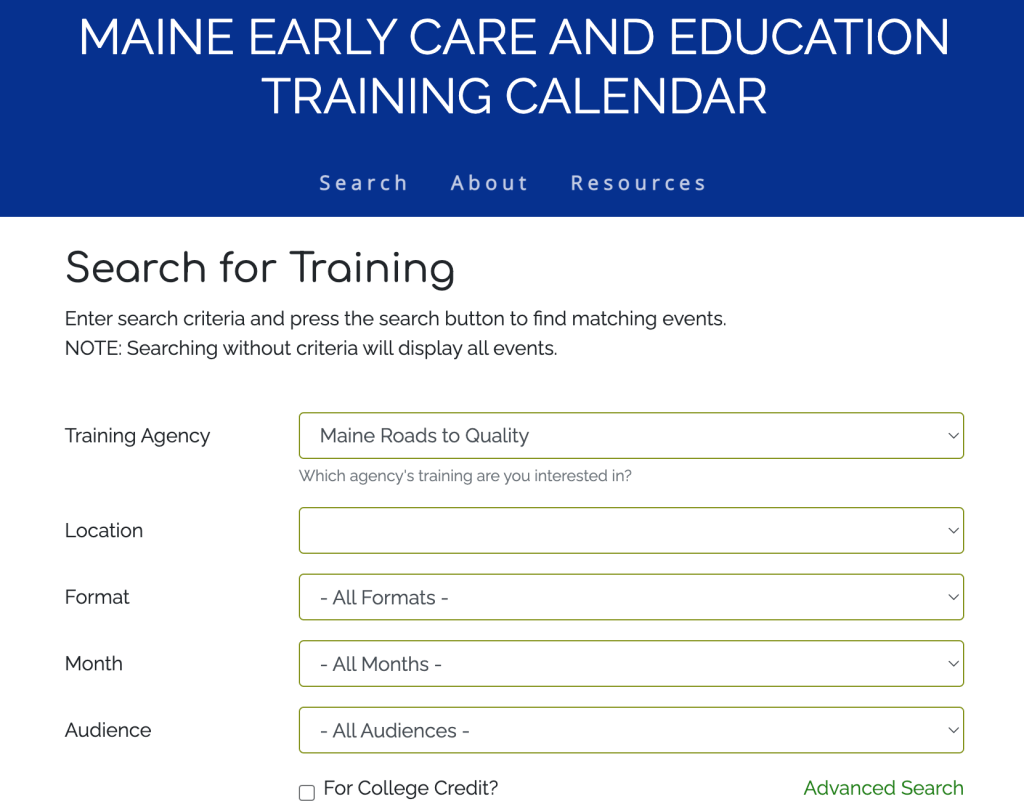
In the menu bar you will see “Training Calendar”. Click on that.
The next page will look something like this:
You can now search trainings from MRTQ as well as other Training Agencies. If you know the name of the training or have a “keyword” you can use the “Advanced Search”
Using Advanced Search for “MELDS” something like this might come up:
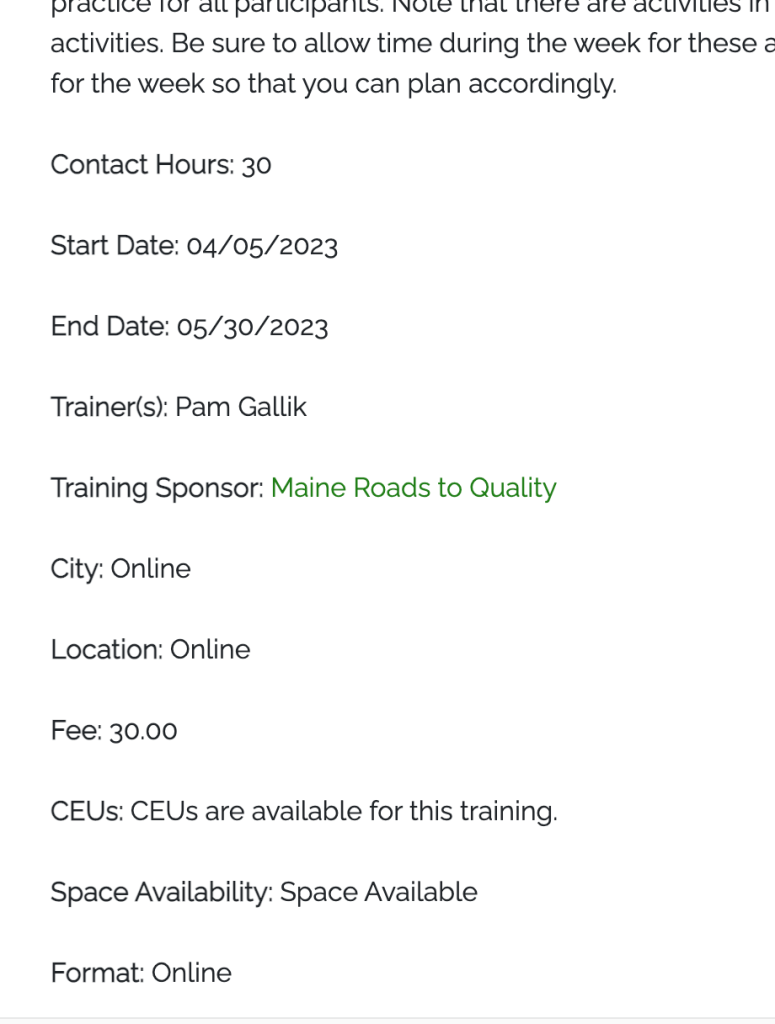
You can now access the training period that works for you by “click here for more information”. You will get description and info on the training / cost / location / price / hours / and space in class. etc.
If space in the trainings then proceed to sign up. If full you will be given the option to sign up on a waiting list. It is recommended that you sign up for the waiting list as MRTQ works to build capacity with new trainings when the list starts to fill up. If there are multiple classes being offered check each you could attend for current openings before adding your name to a wait list.
OR
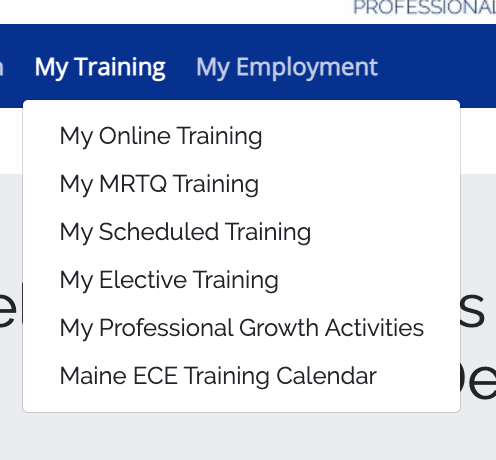
If you access MRTQ from a linked page where you are already logged in to this page you DO NOT need to access Online Training, but use the menu bar. Click “My Training” for the dropdown box and click Maine ECE Training Calendar. Follow the directions explained above for the Calendar Search.
OR
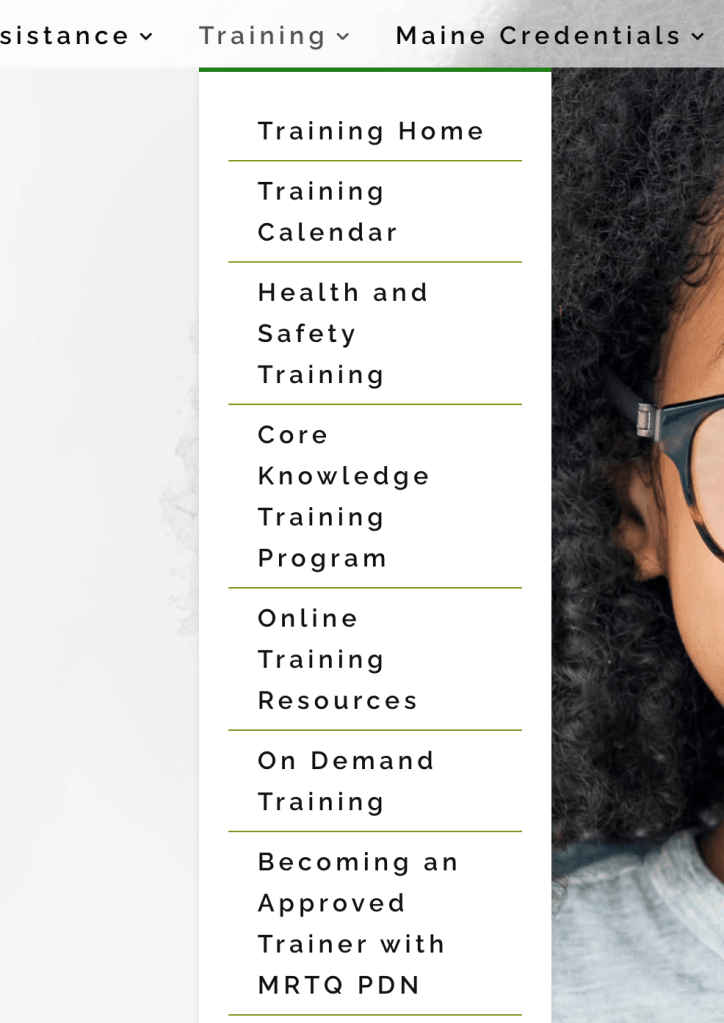
Start from the MRTQ home page (https://mrtq.org/). Hover over “Training” and a drop down menu list will appear.
You will find “Training Calendar”.
Click it.
Follow the directions explained above for the Calendar Search.
Once you have registered for a Calendar Training you access it through the Online Training access button.
Clicking on this button gets you to any MRTQ Trainings you are currently enrolled in. (It also gets you to the Quality Improvement Toolkit if you have already enrolled in it for ongoing access.)
The open page should looks similar to this:
Skip the block of language and scroll down a bit. You will see “My courses” and all the trainings you are enrolled in will be listed.
Click on the training title and you will be at the training itself.
Why is FCCAM posting on this topic? Many providers take the maximum amount of deductions they can each year. That means your net income is significantly less than gross, so ultimately your Social Security benefits will also probably be less than you were expecting.
It’s important to understand how social security benefits are figured.
Benefits are figured off your lifetime earning – the net income you pay yearly taxes on, NOT your gross income.
Adjust or “index” your actual earnings to account for changes in average wages since the year the earnings were received.
Calculate your average indexed monthly earnings during the 35 years in which you earned the most.
Apply a formula to these earnings and arrive at your basic benefit, or “primary insurance amount.”
How do you find out about your status for Social Security benefits?
Set up a personal “my Social Security” account. This site gives you access to: an estimate of your personal retirement benefits; see the effects of different retirement age scenarios; an online Social Security Statement (Statement).
Review your earnings history to make sure everything is accurate. This is important, because your benefit amount is based on how much you’ve earned over your lifetime. If that information is wrong, you may not get the full amount you’re entitled to.
Important Things to Know about Your Social Security Benefits
Social Security benefits are not intended to be your only source of retirement income. You may need other savings, investments, pensions, or retirement accounts to make sure you have enough money when you retire.
You need 40 credits of work (at least 10 years) to qualify for retirement benefits. The amount of your benefit is based on your highest 35 years of earnings. If you have fewer than 35 years of earnings, years without work count as 0 and may reduce your benefit amount.
To keep up with inflation, benefits are adjusted through “cost of living adjustments.”
If you get retirement or disability benefits, your spouse and children also may qualify for benefits.
If you and your spouse both work, use the my Social Security Retirement Calculator to estimate spousal benefits.
If you are divorced and were married for 10 years, you may be able to claim benefits on your ex-spouse’s record. If your ex-spouse receives benefits on your record, that does not affect your or your current spouse’s benefit amounts.
Here’s the initial response: ANY type of emergency disaster drill counts…some options that could be practiced: shelter in place, lost child, simulated relocation (staff, NOT KIDS TRANSPORTED unsafely in cars), severe weather, unknown person/suspicious situation, coming inside due to an emergency, etc.
Here’s the clarification: The language of the Licensing Rule specifies a requirement for 2 evacuation drills in rule SECTION 14. ENVIRONMENT AND SAFETY /Q. Emergency preparedness plan / 2. The Provider must conduct an evacuation drill at least twice a year and the dates must be recorded and be available for review. (Same section for Facility Rule. Q/2 language: The Child Care Facility must conduct an evacuation drill at least twice a year and the dates must be recorded and be available for review. A simulated drill is acceptable.)
The key word is “evacuation“.
Shelter-in-place drills of any kind that do not include evacuation, do not meet the emergency drill needed for rule compliance.
Let’s look at this more:
You already do monthly fire drills with the smoke alarm.
You already have a running log for fire drills.
You need to add 2 noted Evacuation drills to that log.
Reminder: FCC Rule Section 5/A-5: A record of fire drills for the preceding three years must be available for inspection by the Department of Health and Human Services, the Department of Public Safety, State Fire Marshal’s Office, and local fire inspectors.
For fire drills, you use different exits.
Practice any of the other types of safety drills you think would support the children, such as shelter-in-place, reverse evacuation, medical emergency and lost child. Log any Safety Drill you practice.
For evacuation drill:
Simulate it: practice the steps to gather and leave. Use the language specific to evacuation vs fire.
As part of your Emergency Preparedness Plan you should have multiple alternate sites you could evacuate to. It is recommended to have one you can walk to. For a walking site you could actually gather and leave your premises.
You are not required to transport children off the premises. If you do transport children as part of your program, you can practice transporting as part of your drill. If you do not transport, you can practice what loading everyone into a vehicle would be like in an emergency. Simulating this does not put any child in harms way as your vehicle is not running at any point. You just practice loading in, sitting still, and unloading. You could then pretend you are at the safe site and what would you do there?















 fccamaine.com